
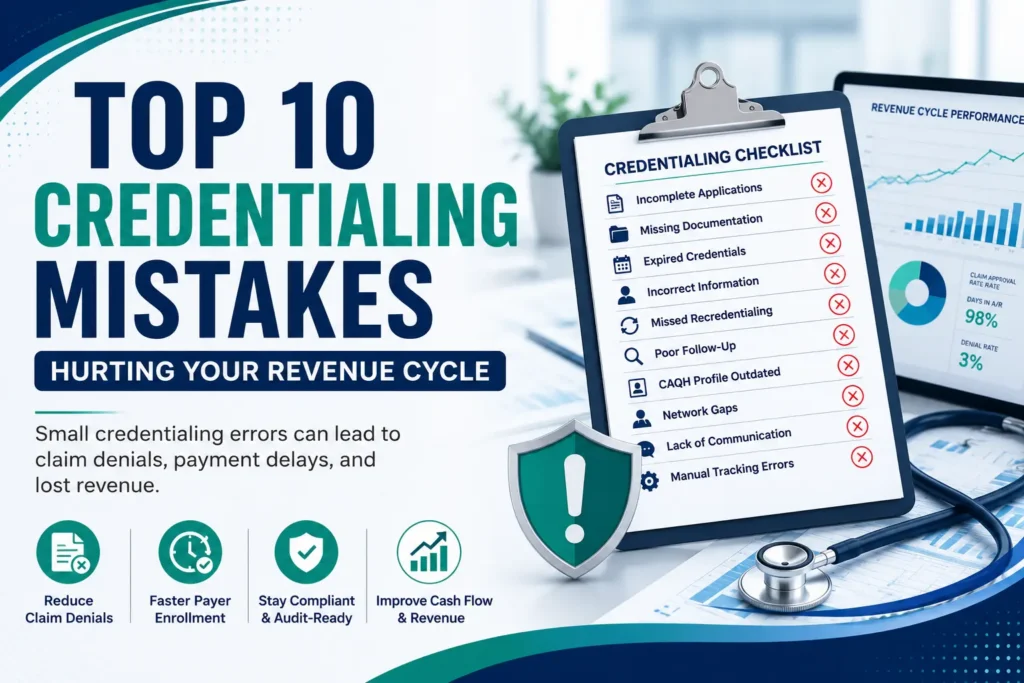
Healthcare providers invest significant time and resources into delivering exceptional patient care, but many practices unknowingly lose thousands of dollars each year because of provider credentialing mistakes. Credentialing is more than an administrative task—it directly impacts reimbursement, payer enrollment, claim approvals, patient satisfaction, and long-term financial performance.
In today’s competitive U.S. healthcare environment, insurance companies have become increasingly strict about provider enrollment, documentation, and compliance. Even a minor credentialing error can delay reimbursements for weeks or months, resulting in denied claims, interrupted cash flow, and increased administrative costs.
At Fine Claim LLC, we help healthcare organizations streamline medical credentialing services, reduce payer enrollment delays, and strengthen their overall Revenue Cycle Management (RCM) strategy. Understanding the most common credentialing mistakes is the first step toward protecting your practice’s revenue.
Why Credentialing Matters in Revenue Cycle Management
Provider credentialing verifies that physicians and healthcare professionals meet the education, licensing, certification, and experience requirements established by insurance payers and regulatory organizations. Without proper credentialing, providers cannot bill many insurance companies, regardless of the quality of care they deliver.
Credentialing serves as the foundation of an efficient Revenue Cycle Management process because payer enrollment must be completed before claims can be reimbursed. When credentialing is delayed or inaccurate, every stage of the revenue cycle suffers—from patient scheduling to final payment collection.
Healthcare organizations that prioritize accurate credentialing typically experience fewer claim denials, faster reimbursements, stronger compliance, and improved patient trust.
Healthcare providers can learn more about provider enrollment requirements through the Council for Affordable Quality Healthcare (CAQH) and Centers for Medicare & Medicaid Services (CMS), both of which establish important credentialing standards for U.S. providers.
1. Waiting Too Long to Start Provider Credentialing
One of the biggest mistakes practices make is waiting until a new provider begins seeing patients before starting the credentialing process.
Insurance enrollment often takes between 60 and 180 days depending on the payer. If credentialing is delayed, providers may deliver services that cannot be reimbursed because payer enrollment has not yet been approved.
Early credentialing helps practices begin billing immediately after providers become active, preventing unnecessary revenue loss.
2. Submitting Incomplete Credentialing Applications
Missing documentation remains one of the leading causes of credentialing delays.
Applications frequently require:
- Medical licenses
- DEA registration
- Board certifications
- Malpractice insurance
- Work history
- Education verification
- Hospital privileges
- NPI information
Even one missing document can cause insurance companies to suspend processing until corrections are received.
Practices should maintain an organized digital credentialing file for every provider to ensure documentation is always current.
3. Ignoring Recredentialing Deadlines
Credentialing is not a one-time event.
Most insurance companies require providers to complete recredentialing every two or three years. Missing renewal deadlines may result in temporary termination from payer networks, interrupted reimbursements, and unnecessary claim denials.
Practices should maintain automated reminders well in advance of expiration dates to avoid disruptions.
Organizations accredited by The Joint Commission also emphasize ongoing provider credentialing compliance.
4. Incorrect Provider Information
Simple administrative mistakes create significant financial consequences.
Common errors include:
- Incorrect provider names
- Wrong practice addresses
- Tax ID mismatches
- NPI inaccuracies
- Outdated phone numbers
- Incorrect specialty designation
Insurance companies compare submitted information across multiple databases. Any discrepancy may delay approvals or reject applications entirely.
Practices should regularly verify provider information before submitting credentialing updates.
5. Not Updating CAQH Profiles Regularly
Many commercial insurance companies rely heavily on CAQH ProView for credentialing verification.
An outdated profile containing expired licenses, malpractice insurance, or certifications can delay payer enrollment.
Providers should review and attest their CAQH information every few months, even if no major changes have occurred.
Maintaining an accurate profile significantly reduces administrative delays.
6. Failing to Track Payer Enrollment Status
Submitting applications is only one part of credentialing.
Practices often assume enrollment will automatically progress without follow-up. Unfortunately, payer applications may remain pending for weeks due to missing documents or processing backlogs.
Regular follow-up with insurance companies helps identify issues before they become lengthy reimbursement delays.
Effective credentialing teams maintain payer-specific tracking systems documenting every communication, submission date, and approval milestone.
7. Credentialing Providers with the Wrong Insurance Networks
Not every insurance plan serves every patient population.
Practices sometimes credential providers with unnecessary payers while overlooking high-volume regional insurance companies.
Analyzing patient demographics before initiating credentialing allows organizations to prioritize the insurance networks that generate the highest reimbursement opportunities.
Strategic payer enrollment improves both patient access and financial performance.
Healthcare market data published by the American Medical Association (AMA) can help providers understand payer participation trends.
8. Poor Communication Between Credentialing and Billing Teams
Credentialing and billing departments often operate independently despite sharing the same revenue goals.
Billing teams may submit claims before credentialing approvals become effective, resulting in avoidable denials.
A coordinated workflow ensures providers are properly enrolled before claims are generated.
Regular communication between credentialing specialists, practice managers, and billing professionals strengthens the entire revenue cycle.
9. Managing Credentialing Manually
Many smaller practices still rely on spreadsheets, paper files, and manual reminders.
As provider networks expand, manual systems become increasingly difficult to manage accurately.
Credentialing software automates:
- Document tracking
- License expiration alerts
- Payer enrollment status
- Renewal reminders
- Compliance reporting
Automation reduces human error while improving administrative efficiency.
The National Committee for Quality Assurance (NCQA) provides widely recognized credentialing standards that support quality healthcare operations.
10. Trying to Handle Credentialing Without Expert Support
Credentialing regulations continue evolving across Medicare, Medicaid, and commercial insurance plans.
Practices that assign credentialing responsibilities to already overloaded administrative staff often experience higher denial rates, slower payer enrollment, and lost revenue.
Professional credentialing specialists stay current with payer requirements, monitor enrollment timelines, resolve documentation issues, and communicate directly with insurance companies.
Partnering with an experienced credentialing team allows physicians and administrators to focus on patient care rather than administrative paperwork.
How Credentialing Errors Impact the Entire Revenue Cycle
Credentialing mistakes affect much more than payer enrollment.
When providers are not properly credentialed, organizations experience delayed reimbursements, increased accounts receivable, higher denial rates, disrupted patient scheduling, additional administrative labor, and reduced overall profitability.
These problems create a chain reaction throughout the revenue cycle. Claims submitted before enrollment approval are often denied outright. Staff members must spend valuable time correcting credentialing issues instead of focusing on patient support or revenue optimization.
Over time, repeated credentialing delays can significantly reduce a practice’s financial stability while negatively affecting patient experience.
Strong credentialing processes improve operational efficiency, shorten reimbursement timelines, and strengthen long-term financial performance.
Best Practices for Preventing Credentialing Mistakes
Successful healthcare organizations treat credentialing as a strategic component of revenue cycle management rather than an occasional administrative requirement.
Maintaining centralized provider documentation, monitoring expiration dates, conducting routine audits, verifying CAQH profiles, following up with payers consistently, and integrating credentialing with billing workflows all contribute to healthier cash flow.
Using experienced credentialing professionals further minimizes costly mistakes while helping providers maintain compliance with Medicare, Medicaid, and commercial insurance requirements.
Organizations that continuously monitor credentialing performance typically experience faster reimbursements, fewer denied claims, and stronger payer relationships.
Why Healthcare Providers Choose Fine Claim LLC
At Fine Claim LLC, we understand that provider credentialing is the gateway to successful revenue cycle management. Our credentialing specialists work closely with physicians, group practices, hospitals, behavioral health providers, and multi-specialty organizations across the United States to simplify enrollment and eliminate unnecessary delays.
Our comprehensive credentialing support includes provider enrollment, Medicare and Medicaid applications, commercial insurance credentialing, CAQH profile management, recredentialing, payer follow-up, compliance monitoring, and ongoing credential maintenance.
Combined with our complete medical billing services, coding expertise, denial management, and revenue cycle optimization, we help healthcare organizations reduce administrative burdens while maximizing reimbursements.
Whether your practice is onboarding new providers or improving existing credentialing workflows, Fine Claim LLC delivers accurate, compliant, and timely solutions designed for long-term financial success.
Final Thoughts
Credentialing is often overlooked until reimbursement problems arise, yet it remains one of the most important components of a healthy healthcare revenue cycle. Small administrative mistakes can delay payer enrollment, increase claim denials, disrupt cash flow, and reduce overall practice profitability.
By starting credentialing early, maintaining accurate provider records, tracking payer enrollment, updating CAQH profiles, meeting recredentialing deadlines, and partnering with experienced professionals, healthcare organizations can protect revenue while improving operational efficiency.
If your practice wants to reduce credentialing delays, accelerate payer enrollment, and strengthen every stage of the revenue cycle, Fine Claim LLC provides the expertise and dedicated support needed to keep your organization financially healthy while allowing providers to focus on delivering exceptional patient care.
Frequently Asked Questions (FAQs)
1. What is provider credentialing in medical billing?
Provider credentialing is the process of verifying a healthcare provider’s education, licenses, certifications, work history, malpractice insurance, and professional qualifications before enrolling them with insurance companies. Proper credentialing allows providers to bill Medicare, Medicaid, and commercial insurance plans for covered services.
2. Why is credentialing important for revenue cycle management?
Credentialing is the foundation of an efficient revenue cycle because providers must be enrolled with insurance payers before claims can be reimbursed. Delayed or inaccurate credentialing can lead to claim denials, payment delays, increased accounts receivable (AR), and lost revenue.
3. What are the most common credentialing mistakes?
Some of the most common credentialing mistakes include:
- Starting the credentialing process too late
- Submitting incomplete applications
- Missing recredentialing deadlines
- Providing inaccurate provider information
- Failing to update CAQH profiles
- Not following up on payer enrollment
- Poor communication between credentialing and billing teams
- Managing credentialing manually without proper tracking
4. How long does provider credentialing take in the United States?
The credentialing timeline varies by payer but generally takes 60 to 180 days. Medicare, Medicaid, and commercial insurance companies each have different processing requirements, making early application submission essential to avoid reimbursement delays.
5. How does credentialing affect claim denials?
If a provider is not properly credentialed or enrolled with an insurance company, claims may be denied or rejected even when medical services were appropriately delivered. Proper credentialing significantly reduces preventable billing errors and reimbursement delays.