
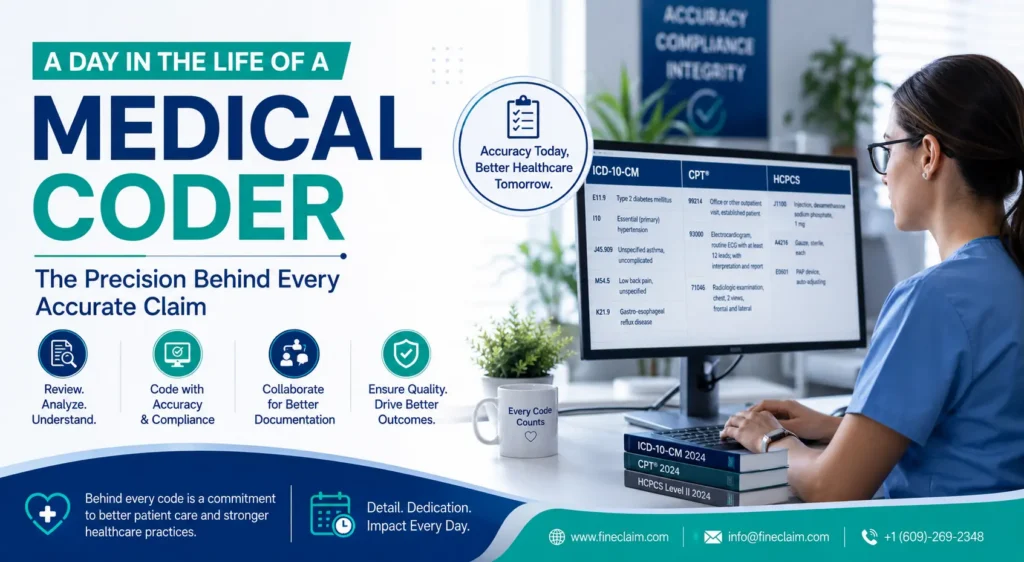
Healthcare providers rely on more than excellent patient care to keep their practices running efficiently. Every diagnosis, treatment, laboratory test, imaging service, and surgical procedure must be translated into standardized medical codes before insurance claims can be processed. This responsibility falls on medical coders, professionals who work behind the scenes to ensure healthcare organizations receive proper reimbursement while maintaining regulatory compliance.
Understanding A Day in the Life of a Medical Coder provides valuable insight into how the U.S. healthcare revenue cycle functions. Medical coders serve as the bridge between clinical documentation and financial reimbursement, making their role essential for hospitals, physician practices, specialty clinics, ambulatory surgery centers, and healthcare organizations across the United States.
At Fine Claim LLC, our experienced coding professionals work with providers across multiple specialties to improve coding accuracy, reduce denials, and maintain compliance with ever-changing healthcare regulations.
In this article, we’ll explore what a typical workday looks like for a medical coder, the responsibilities they manage, the technology they use, and why their expertise directly impacts a healthcare organization’s financial success.
Who Is a Medical Coder?
A medical coder reviews clinical documentation created by physicians and other healthcare professionals and converts that information into standardized codes using ICD-10-CM, CPT, and HCPCS Level II code sets.
These codes communicate patient diagnoses, procedures, and services to insurance companies, including Medicare, Medicaid, and commercial payers. Accurate coding ensures providers receive appropriate reimbursement while meeting federal and payer-specific documentation requirements.
Medical coders work closely with physicians, billers, compliance officers, and revenue cycle teams to support efficient claim submission and payment.
If coding errors occur, claims may be delayed, denied, underpaid, or flagged for audits.
Starting the Morning: Reviewing the Work Queue
A typical day begins by logging into the Electronic Health Record (EHR) system and reviewing assigned patient encounters from the previous day.
The coder prioritizes cases based on urgency, payer deadlines, specialty requirements, and provider workload. Emergency department visits, surgical procedures, inpatient discharges, and high-value claims often receive priority attention.
During this stage, coders review:
- Physician notes
- Operative reports
- Progress notes
- Laboratory results
- Imaging reports
- Discharge summaries
- Consultation documentation
Every detail must support the diagnosis and procedure codes selected later in the coding process.
Practices that combine accurate coding with Medical Billing Services often experience faster claim processing and fewer reimbursement delays.
Carefully Reading Clinical Documentation
The majority of a coder’s day involves carefully analyzing medical records.
Medical coders don’t simply assign codes based on keywords. Instead, they interpret complete clinical documentation to understand the patient’s condition, medical necessity, procedures performed, complications, and treatment plan.
For example, a patient with diabetes may have several associated conditions that require additional diagnosis codes. Surgical procedures may involve multiple CPT codes along with modifiers that accurately represent the services provided.
Strong documentation is the foundation of quality coding.
When physician documentation lacks specificity, coders may initiate provider queries requesting clarification before coding the encounter.
Selecting the Correct ICD-10-CM Diagnosis Codes
Once documentation has been reviewed, the coder identifies the appropriate diagnosis codes using the ICD-10-CM classification system.
Diagnosis coding requires careful attention to:
- Laterality
- Disease severity
- Chronic versus acute conditions
- Complications
- Manifestations
- Underlying causes
- Encounter type
Choosing an incorrect diagnosis code can affect reimbursement, medical necessity validation, quality reporting, and payer approval.
Medical coders continually reference official coding guidelines published by the Centers for Medicare & Medicaid Services (CMS) and the National Center for Health Statistics (NCHS) to ensure compliance.
Assigning CPT and HCPCS Procedure Codes
After diagnosis coding, attention shifts to procedure coding.
Procedures performed during patient encounters must be accurately represented using CPT and HCPCS codes.
This process requires understanding:
- Surgical techniques
- Office procedures
- Diagnostic imaging
- Laboratory testing
- Vaccinations
- Durable medical equipment
- Evaluation and Management (E/M) services
Even small coding mistakes may result in claim denials or underpayments.
Coders frequently verify updates published by the American Medical Association (AMA) to stay current with annual CPT code revisions.
Reviewing Coding Compliance Throughout the Day
Compliance is not a separate task—it is integrated into every coding decision.
Medical coders ensure that every assigned code is fully supported by physician documentation and complies with:
- HIPAA regulations
- Medicare policies
- National Correct Coding Initiative (NCCI)
- Local Coverage Determinations
- Commercial payer guidelines
Healthcare organizations depend on coding accuracy to reduce audit risks and avoid costly penalties.
Practices often strengthen compliance by partnering with experienced Medical Coding Services providers that maintain ongoing coder education.
Collaborating with Physicians and Billing Teams
Medical coding is highly collaborative.
Throughout the day, coders communicate with physicians, clinical staff, documentation specialists, and billing departments.
Common discussions include:
- Documentation clarification
- Missing procedure details
- Modifier selection
- Medical necessity questions
- Diagnosis specificity
- Insurance requirements
This collaboration improves claim accuracy before submission and reduces downstream denials.
Many healthcare organizations integrate coding with Revenue Cycle Management Services to improve communication between departments.
Working with Coding Software and EHR Systems
Modern medical coders use sophisticated healthcare technology rather than paper charts.
Their daily workflow typically includes:
- Electronic Health Records (EHR)
- Practice Management Software
- Computer-Assisted Coding (CAC)
- Encoder software
- Claims management systems
- Compliance auditing tools
Technology improves productivity, but coders must still rely on clinical judgment rather than automated suggestions.
Artificial intelligence assists coding workflows, yet human expertise remains essential for complex medical cases.
Managing Claim Edits Before Submission
Before claims move to the billing department, coders often review system-generated edits.
These edits identify potential issues such as:
- Missing modifiers
- Invalid diagnosis combinations
- Gender conflicts
- Age-related coding errors
- Duplicate procedures
- Bundled services
- Documentation inconsistencies
Resolving these issues before claim submission helps reduce payer rejections.
Organizations that combine coding with Denial Management Services often experience higher first-pass claim acceptance rates.
Continuous Learning Never Stops
One unique aspect of A Day in the Life of a Medical Coder is continuous education.
Healthcare regulations change frequently.
Every year brings:
- New ICD-10 diagnosis codes
- CPT revisions
- HCPCS updates
- Medicare payment policy changes
- Documentation requirements
- Specialty-specific coding rules
Professional coders dedicate time each week to reviewing coding updates, attending webinars, earning continuing education credits, and participating in certification renewal programs.
This commitment ensures coding accuracy remains aligned with current industry standards.
Specialty Coding Requires Advanced Expertise
Not every medical coder performs identical work.
Many specialize in fields such as:
- Cardiology
- Orthopedics
- Neurology
- Oncology
- Dermatology
- Behavioral Health
- Physical Therapy
- Radiology
- Gastroenterology
- Urology
Each specialty has unique documentation requirements, coding guidelines, and payer expectations.
Specialty expertise often improves coding accuracy and reimbursement outcomes.
Healthcare organizations frequently outsource specialty coding to experienced partners like Fine Claim LLC, where certified coders understand complex specialty-specific requirements.
The Impact Medical Coders Have on Revenue Cycle Performance
Although patients rarely meet medical coders, their work directly affects the financial health of healthcare organizations.
Accurate coding contributes to:
- Faster reimbursements
- Reduced claim denials
- Improved compliance
- Higher clean claim rates
- Better provider productivity
- Lower audit risk
- Improved patient billing accuracy
Even a single coding error can trigger payment delays that impact practice cash flow.
By maintaining coding precision from the beginning of the revenue cycle, medical coders help providers focus on delivering quality patient care.
Challenges Medical Coders Face Every Day
Medical coding is rewarding, but it requires exceptional attention to detail.
Common daily challenges include interpreting incomplete physician documentation, adapting to frequent payer policy changes, keeping pace with annual code updates, managing productivity expectations, and balancing speed with accuracy. Coders must also understand specialty-specific guidelines while ensuring every code accurately reflects the documented clinical encounter.
Successful coders overcome these challenges through continuous education, strong analytical skills, and adherence to official coding standards.
Why Healthcare Providers Choose Professional Medical Coding Services
As healthcare regulations become increasingly complex, many U.S. providers choose to outsource coding rather than manage large in-house teams.
Professional coding partners provide certified expertise, scalable staffing, quality assurance reviews, compliance monitoring, and ongoing education. This approach helps practices improve coding accuracy, reduce administrative burdens, and maintain consistent reimbursement performance.
At Fine Claim LLC, our certified coding specialists support healthcare providers across multiple specialties with accurate code assignment, compliance-focused workflows, and seamless integration into the revenue cycle. By combining clinical expertise with industry best practices, we help providers reduce denials, optimize reimbursement, and stay compliant with evolving healthcare regulations.
Whether serving independent physician practices, specialty clinics, ambulatory surgery centers, or large healthcare organizations, our goal is to deliver coding solutions that strengthen financial performance while allowing providers to focus on exceptional patient care.
Conclusion
Understanding A Day in the Life of a Medical Coder reveals just how essential these professionals are to the U.S. healthcare system. From reviewing clinical documentation and assigning accurate diagnosis and procedure codes to collaborating with providers and ensuring regulatory compliance, every step they take influences reimbursement, claim accuracy, and overall revenue cycle performance.
Medical coding is far more than entering numbers into a system. It requires deep clinical knowledge, analytical thinking, continuous education, and a commitment to precision. As healthcare continues to evolve, skilled medical coders remain indispensable to maintaining efficient operations and financial stability for healthcare organizations.
At Fine Claim LLC, we recognize the critical role coding plays in successful revenue cycle management. Our experienced coding professionals help healthcare providers improve documentation accuracy, reduce denials, support compliance, and maximize reimbursement—allowing practices across the United States to operate more efficiently while delivering outstanding patient care.