
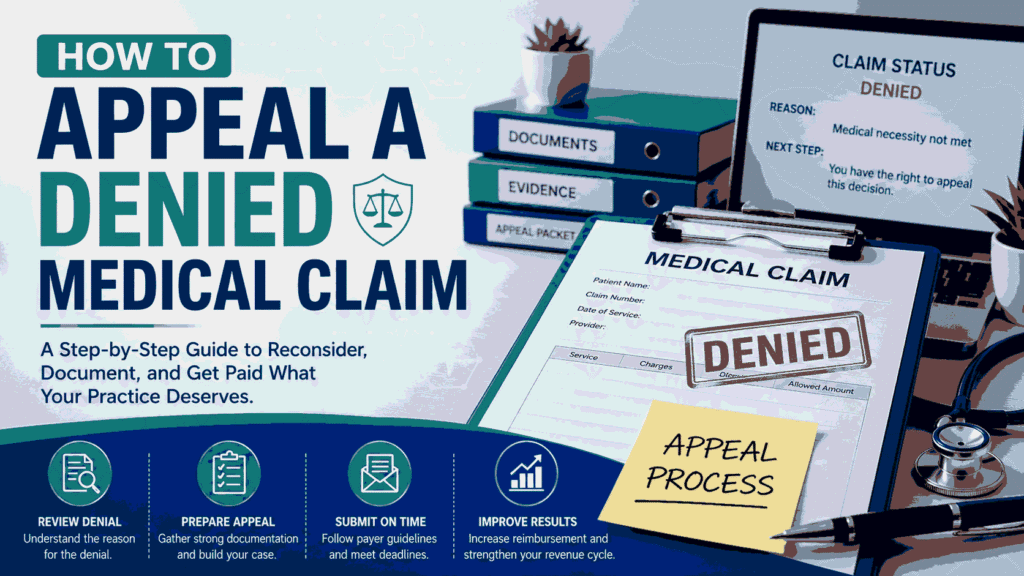
Medical claim denials are a common challenge for healthcare providers, physician practices, hospitals, and medical groups across the United States. A denied claim can delay reimbursement, increase accounts receivable, consume staff resources, and negatively affect a practice’s cash flow. Understanding how to appeal a denied medical claim can help providers recover legitimate reimbursement while identifying the underlying issues responsible for recurring denials.
A successful claim appeal is more than simply sending a claim back to an insurance company. It requires careful review of the denial reason, claim information, medical documentation, payer requirements, coding, authorization records, and applicable appeal deadlines. The goal is to demonstrate clearly why the claim should be reconsidered and paid.
For U.S. healthcare providers, an organized medical claim appeal process should be part of a broader revenue cycle strategy. When appeals are handled consistently and denial trends are analyzed, practices can recover more revenue while reducing preventable claim problems.
What Is a Medical Claim Appeal?
A medical claim appeal is a formal request asking a health insurance company or health plan to reconsider a decision to deny or reduce payment for a healthcare service. An appeal may address issues involving medical necessity, coverage, coding, authorization, eligibility, documentation, or other payer requirements.
According to HealthCare.gov appeal guidance, consumers generally have the right to request an internal appeal when a health plan denies a claim or coverage, and certain situations may also qualify for external review.
For healthcare providers, the first step is determining whether the claim needs an appeal or a correction. A claim containing an incorrect CPT code, modifier, patient demographic, authorization number, or other billing detail may require correction and resubmission rather than a formal appeal.
On the other hand, if the original claim was accurate but the payer incorrectly determined that the service was not medically necessary or covered, an appeal may be appropriate.
Understanding this distinction helps billing teams avoid spending time appealing claims that should simply be corrected.
Why Are Medical Claims Denied?
Insurance companies can deny claims for many different reasons. Common causes include eligibility problems, missing prior authorization, incorrect coding, insufficient documentation, medical necessity issues, duplicate claims, non-covered services, incorrect modifiers, coordination of benefits problems, and timely filing.
Some denials occur because information was incorrect when the claim was submitted. Others result from differences between the provider’s documentation and the payer’s reimbursement policies.
For example, a claim may be denied because the patient’s insurance was inactive on the date of service. Another claim may be denied because the payer required prior authorization but the authorization was missing or did not cover the procedure performed.
Medical necessity denials can require a more detailed review because the provider may need to demonstrate why the service was clinically appropriate for the patient.
A strong denial management services strategy can help practices identify recurring denial patterns and determine whether the root cause is related to coding, eligibility, authorization, documentation, or payer-specific requirements.
How to Appeal a Denied Medical Claim
The process for appealing a denied medical claim can vary depending on the insurance company, health plan, claim type, and reason for denial. Providers should always follow the specific instructions included in the payer’s denial notice.
Review the Denial Carefully
The first step in appealing a denied medical claim is to understand exactly why the claim was denied.
Review the Explanation of Benefits (EOB), electronic remittance advice (ERA), payer portal, claim history, and denial notification. Look for the denial reason, claim adjustment reason code, remark code, payer instructions, and appeal deadline.
Do not rely only on a short denial description. Compare the denial with the original claim and the patient’s medical record.
For example, if the payer denied the claim for lack of medical necessity, determine which clinical requirement the payer believes was not met. If the denial involves authorization, verify whether authorization was obtained and whether the authorization matches the date of service, procedure, units, and provider.
This initial investigation determines whether the claim should be corrected, reconsidered, or formally appealed.
Determine Whether the Claim Needs Correction or Appeal
Not every denied claim requires an appeal.
Suppose a claim was denied because the billing team entered an incorrect modifier. In that situation, the appropriate solution may be a corrected claim rather than an appeal arguing that the original claim was correct.
However, if the modifier was correctly reported and the payer incorrectly processed the claim, an appeal may be justified.
The same principle applies to diagnosis codes, procedure codes, authorization information, provider information, and patient demographics.
Coordination between medical billing and coding teams is therefore important. Coding professionals can review whether the reported services and diagnoses accurately reflect the medical documentation, while billing specialists can evaluate payer requirements and claim history.
Check the Appeal Deadline
One of the most important steps in the medical claim appeal process is identifying the applicable filing deadline.
There is no universal deadline for every U.S. health insurance claim. Commercial insurance plans, Medicare, Medicare Advantage, Medicaid programs, and other payers can have different requirements.
For certain HealthCare.gov-regulated plans, HealthCare.gov states that an internal appeal generally must be filed within 180 days after receiving notice that a claim was denied.
Medicare Advantage has its own requirements. CMS states that reconsideration requests generally must be filed with the Medicare Advantage health plan within 65 calendar days from the date of the organization determination notice.
Providers should therefore review the payer’s denial letter and applicable provider manual instead of assuming that one deadline applies to every claim.
A well-organized medical billing services workflow should include denial tracking so appeal deadlines are not missed.
Gather the Required Documentation
Strong documentation is one of the most important components of a successful appeal.
Depending on the denial, the appeal package may include medical records, physician notes, operative reports, treatment plans, laboratory or imaging reports, prior authorization documentation, referrals, eligibility information, claim forms, EOBs, payer correspondence, and relevant clinical information.
The documentation should directly address the payer’s reason for denial.
For example, when appealing a medical necessity denial, the clinical documentation should demonstrate why the service was appropriate for the patient’s condition. When appealing a coding denial, the documentation should support the reported procedure, diagnosis, modifier, or other coding information.
The goal is not to send every document available. Instead, provide relevant evidence that makes it easier for the payer’s reviewer to understand the case.
Prepare a Clear Appeal Letter
A professional medical claim appeal letter should be concise, factual, and specific.
The letter should identify the patient, provider, date of service, claim number, and amount in dispute. It should explain the reason for the original denial and clearly state why the provider believes the decision should be reconsidered.
For a coding-related denial, the appeal can explain why the reported code accurately represents the service provided. For a medical necessity denial, the provider can explain the clinical circumstances and reference supporting documentation.
Avoid vague statements such as “the claim should be paid.” Instead, explain what happened, why the denial is incorrect or why reconsideration is warranted, and what documentation supports the request.
A well-structured appeal gives the payer’s reviewer a clear path from the denial reason to the evidence supporting payment.
Submit the Appeal Correctly
After the appeal package is prepared, submit it according to the payer’s instructions.
Depending on the insurer, appeals may be submitted through a provider portal, electronic submission system, fax, mail, or another designated process.
Keep a copy of the complete appeal package and document the submission date, method, confirmation number, and any tracking information.
Following up after submission is also important. An appeal should not disappear into an accounts receivable queue simply because the initial documentation was submitted.
What Documentation Helps Support a Medical Claim Appeal?
The documentation required depends on the denial reason.
A medical necessity appeal may require clinical notes, diagnostic results, treatment history, physician statements, and other evidence showing why the service was appropriate.
An authorization-related appeal may require the authorization number, authorization dates, approved procedure codes, number of units, and correspondence between the provider and payer.
A coding appeal may require the medical record and an explanation of why the selected CPT, HCPCS, or ICD-10-CM codes accurately represent the services and diagnoses.
A timely filing appeal may require proof that the original claim was submitted within the payer’s required timeframe, such as a clearinghouse acceptance report or payer confirmation.
The key principle is simple: the documentation should directly address the reason for denial.
What Happens After the First Appeal?
If the payer upholds the original denial, the provider should review the decision to determine whether another level of appeal or reconsideration is available.
The process varies considerably by payer and plan.
For Medicare Advantage, CMS describes a multi-level appeals structure. If a Medicare Advantage plan makes an unfavorable reconsideration decision, the case may proceed to review by the Part C Independent Review Entity under applicable rules.
For certain commercial health plans, an external review may also be available after an internal appeal. HealthCare.gov explains that an external review involves an independent third party reviewing certain eligible disputes rather than allowing the insurer to make the final decision.
Providers should carefully read the next-level appeal instructions included with the payer’s decision. Missing the next deadline can eliminate an otherwise valid opportunity for reconsideration.
What Is the Difference Between Internal and External Appeals?
An internal appeal is reviewed within the health plan or insurance company. The provider or patient asks the insurer to reconsider its original decision.
An external review is conducted by an independent third party when the case qualifies under applicable federal or state requirements.
According to HealthCare.gov internal appeal requirements, certain health plan denials can be challenged through an internal appeal, and the insurer must provide information about the appeal process.
HealthCare.gov also provides information about external review rights for qualifying cases.
Because state and federal rules can differ by plan type, providers should always verify the applicable process before escalating an appeal.
How Medicare Claim Appeals Work
Medicare claim appeals follow specific rules that can differ from commercial insurance processes.
For Original Medicare, CMS provides a defined appeals process that can include redetermination, reconsideration, Administrative Law Judge review, Medicare Appeals Council review, and judicial review when applicable.
CMS explains the Medicare claim appeal requirements for subsequent levels of appeal. For example, a second-level Medicare reconsideration request generally must be filed within 180 days after receipt of the redetermination decision.
Medicare Advantage follows a different process. Providers and beneficiaries should use the applicable plan’s instructions and review the current CMS Medicare Advantage appeal process when dealing with Part C decisions.
These differences demonstrate why healthcare organizations should avoid applying the same appeal workflow to every payer.
How Denial Management Can Improve Appeal Success
Appealing individual claims is only one part of effective denial management. A practice should also determine why claims are being denied in the first place.
If a provider repeatedly receives eligibility denials, the practice may need to strengthen insurance eligibility verification before appointments.
If authorization denials are common, the scheduling and authorization workflow may need improvement. If coding denials occur frequently, the practice may benefit from a coding audit or additional documentation review.
Recurring denials should be categorized by payer, denial reason, provider, CPT code, specialty, location, and other relevant factors. This information can reveal patterns that would otherwise remain hidden.
Fine Claim LLC supports healthcare organizations with revenue cycle management services that can help practices manage billing workflows, claims, denials, and accounts receivable more efficiently.
A comprehensive RCM approach connects front-end processes such as eligibility and authorization with coding, claim submission, denial follow-up, and payment posting.
How to Prevent Medical Claim Denials
The best appeal strategy is to prevent avoidable denials before claims are submitted.
Practices should verify insurance eligibility before services are provided, confirm authorization requirements when applicable, maintain accurate patient demographics, use appropriate coding, submit complete documentation, and monitor payer-specific billing rules.
Regular claim audits can also identify errors before they become payment problems.
Another important strategy is monitoring denial trends. If a practice sees the same denial repeatedly, simply appealing every claim may not solve the problem. Management should investigate the root cause and modify the workflow.
For example, repeated authorization denials may indicate communication gaps between scheduling and authorization teams. Repeated coding denials may indicate documentation or coding inconsistencies. Frequent eligibility denials may indicate that verification is occurring too early or not being repeated when patient information changes.
Effective accounts receivable management services can also help practices prioritize unpaid claims, monitor aging balances, and follow up on outstanding reimbursement.
Frequently Asked Questions About Appealing Denied Medical Claims
Can a healthcare provider appeal a denied medical claim?
Yes. Depending on the payer and plan, healthcare providers may have the ability to request reconsideration or appeal a denied claim. The specific process depends on the insurance plan, denial reason, provider status, and applicable rules.
How long do I have to appeal a denied medical claim?
The deadline depends on the payer and type of coverage. Certain HealthCare.gov-regulated plans generally allow 180 days for an internal appeal, while Medicare and Medicare Advantage have their own appeal timeframes. Always follow the deadline stated in the applicable denial notice and payer requirements.
What should a medical claim appeal letter include?
A strong appeal letter generally identifies the patient, provider, claim number, date of service, denial reason, amount in dispute, explanation supporting reconsideration, and relevant documentation.
Should I appeal a denied claim or submit a corrected claim?
It depends on the denial. If the claim contains a factual or billing error, a corrected claim may be appropriate. If the original claim was accurate and the payer’s decision is being challenged, an appeal may be more appropriate.
Can a medical necessity denial be appealed?
Yes. Medical necessity denials may qualify for an internal appeal and, in certain circumstances, external review. The appeal should include documentation that supports the clinical appropriateness of the service. HealthCare.gov identifies medical judgment and medical necessity as examples of issues that may qualify for external review under applicable requirements.
What happens if an insurance company denies the first appeal?
Depending on the plan, additional appeal levels or external review may be available. Providers should review the payer’s determination letter for instructions about the next level of review and its deadline.
Final Thoughts
Learning how to appeal a denied medical claim is an essential skill for healthcare providers and medical billing teams operating in the U.S. A successful appeal requires more than resubmitting the original claim. It requires identifying the denial reason, determining whether correction or appeal is appropriate, gathering relevant documentation, preparing a clear explanation, meeting the payer’s deadline, and tracking the case through resolution.
At the same time, healthcare organizations should use denial data to improve their overall revenue cycle. Repeated denials can indicate problems with eligibility verification, authorization, documentation, coding, claim submission, or payer-specific workflows.
Fine Claim LLC helps healthcare organizations strengthen these processes through comprehensive medical billing services, revenue cycle management services, denial follow-up, coding support, and accounts receivable management. By combining proactive denial prevention with disciplined claim appeal procedures, healthcare practices can improve reimbursement efficiency and build a more sustainable revenue cycle.