
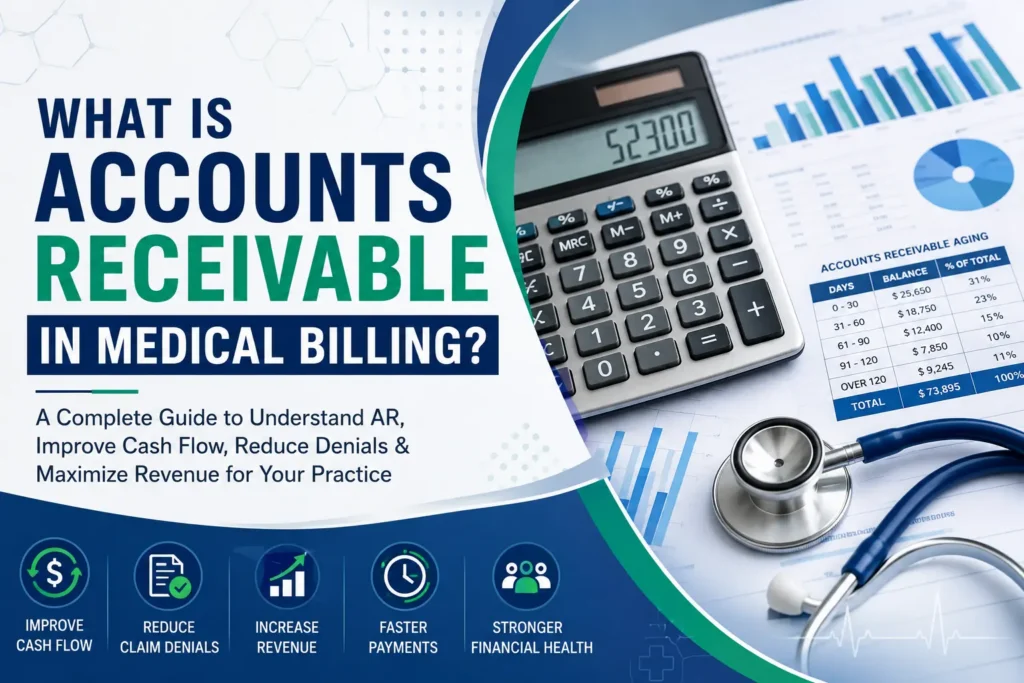
Healthcare providers in the United States rely on timely reimbursements to maintain financial stability and deliver quality patient care. However, delayed payments, denied claims, and unpaid balances can significantly impact a practice’s revenue cycle. This is where accounts receivable in medical billing becomes one of the most important components of healthcare financial management.
Accounts receivable (AR) in medical billing refers to the money owed to healthcare providers by insurance companies and patients for medical services already delivered. Every claim that has been submitted but not yet paid falls under accounts receivable. Effective AR management ensures that healthcare organizations receive payments faster, reduce denials, and maintain healthy cash flow.
At Fine Claim LLC, we help physicians, hospitals, and healthcare organizations optimize their revenue cycle through expert medical billing services, proactive AR follow-up, and denial management solutions designed for the US healthcare market.
Understanding Accounts Receivable in Medical Billing
In simple terms, accounts receivable represents outstanding payments due to a healthcare provider. When a patient receives treatment, the provider submits a claim to the insurance company. Until the payment is received, the amount remains in accounts receivable.
For example, if a cardiology clinic submits claims worth $100,000 to various insurance companies and receives only $70,000 in payments, the remaining $30,000 is considered AR until the balances are collected.
Efficient AR processes are critical because delayed payments can affect payroll, operational costs, staffing, technology investments, and overall financial health.
Healthcare practices often partner with professional medical billing services providers like Fine Claim LLC to improve collections and reduce aging receivables.
Why Accounts Receivable Is Important in Medical Billing
Accounts receivable management is more than collecting unpaid claims. It directly impacts the profitability of a healthcare organization.
A well-managed AR process helps providers:
- Improve cash flow
- Reduce claim denials
- Minimize payment delays
- Identify billing errors
- Increase revenue collection
- Lower bad debt
According to the American Medical Association (AMA), efficient revenue cycle management can significantly improve financial outcomes for medical practices. Providers who actively monitor AR performance are better equipped to identify reimbursement issues and optimize operations.
Healthcare organizations also benefit from implementing advanced revenue cycle management services to strengthen financial performance and improve operational efficiency.
How the Accounts Receivable Process Works
The AR process begins immediately after patient services are provided.
The provider documents services using accurate medical codes, and the billing team submits claims to insurance payers. Insurance companies then review the claims and either approve, deny, reject, or request additional information.
Once payments are received, balances are posted. Any unpaid amount remains in accounts receivable and requires follow-up.
The AR workflow generally includes:
Patient Registration → Insurance Verification → Medical Coding → Claim Submission → Payment Posting → AR Follow-Up → Denial Resolution → Final Collection
Errors during any stage can create payment delays, making strong medical coding services and billing accuracy essential for successful AR management.
Understanding AR Aging in Medical Billing
One of the most important concepts in accounts receivable management is AR aging.
AR aging categorizes unpaid claims based on the number of days they remain outstanding. Healthcare providers commonly track:
- 0–30 Days
- 31–60 Days
- 61–90 Days
- 91–120 Days
- Over 120 Days
Claims that remain unpaid for longer periods become increasingly difficult to collect.
Industry experts recommend maintaining most receivables within the 30 to 60-day range. Excessive balances over 90 days often indicate process inefficiencies, payer issues, or insufficient follow-up.
For guidance on healthcare financial management, providers often refer to resources from the Healthcare Financial Management Association (HFMA).
Common Causes of High Accounts Receivable
Many healthcare providers struggle with growing AR because of avoidable billing errors and operational challenges.
Common causes include:
- Incorrect patient demographics
- Insurance eligibility issues
- Coding errors
- Missing documentation
- Delayed claim submission
- Underpayments
- Claim denials
- Poor follow-up processes
Practices that invest in accurate eligibility verification services can significantly reduce claim rejections before submission.
Likewise, proactive denial management services help recover unpaid claims and improve reimbursement rates.
Key Metrics Used in AR Management
Healthcare organizations use several key performance indicators (KPIs) to measure AR efficiency.
One important metric is Days in Accounts Receivable, which indicates how long it takes to collect payments.
Another metric is the AR Aging Percentage, which measures claims over specific aging periods.
Clean Claim Rate, Denial Rate, and Collection Rate are also essential indicators.
The Medical Group Management Association (MGMA) recommends regularly monitoring revenue cycle metrics to maintain financial stability.
Monitoring these indicators helps providers identify issues early and improve reimbursement performance.
Best Practices for Effective AR Management
Successful accounts receivable management requires a proactive approach.
Healthcare providers should verify insurance coverage before services are rendered, submit claims promptly, and ensure coding accuracy.
Regular follow-up on unpaid claims is essential, particularly for balances exceeding 30 days.
Using advanced billing technology and outsourcing to experienced partners can also improve collections.
At Fine Claim LLC, our AR specialists use data-driven strategies to monitor aging reports, track payer trends, and recover outstanding claims efficiently.
Many providers combine AR services with comprehensive accounts receivable services and revenue cycle management solutions to maximize collections.
The Role of Technology in Medical Billing AR
Technology has transformed accounts receivable management in healthcare.
Modern billing software automates claim tracking, identifies denials, monitors payer performance, and generates real-time AR reports.
Artificial intelligence and analytics tools can predict reimbursement delays and highlight collection opportunities.
The growing use of automation has enabled healthcare organizations to reduce manual work and improve financial outcomes.
The Centers for Medicare & Medicaid Services (CMS) also provides valuable information about reimbursement policies and claim processing requirements.
Why Outsourcing Accounts Receivable Services Makes Sense
Many US healthcare providers choose to outsource AR management to specialized medical billing companies.
Outsourcing offers access to experienced billing professionals, advanced technology, payer expertise, and dedicated follow-up teams.
This approach reduces administrative burdens and allows physicians to focus more on patient care.
Professional AR services can help practices:
- Increase collections
- Lower aging balances
- Reduce denials
- Improve cash flow
- Strengthen revenue cycle performance
Fine Claim LLC provides customized AR management solutions for physician groups, hospitals, specialty practices, and healthcare organizations across the United States.
Conclusion
Understanding what accounts receivable in medical billing is is essential for maintaining a financially healthy healthcare practice. AR management represents far more than unpaid claims—it is a critical component of revenue cycle success.
By improving billing accuracy, reducing denials, following up on unpaid balances, and leveraging expert support, healthcare providers can enhance cash flow and increase profitability.
For practices seeking better financial outcomes, partnering with an experienced company like Fine Claim LLC can make a significant difference. Through advanced AR management, denial prevention, and revenue cycle optimization, healthcare organizations can strengthen collections while continuing to provide exceptional patient care.