
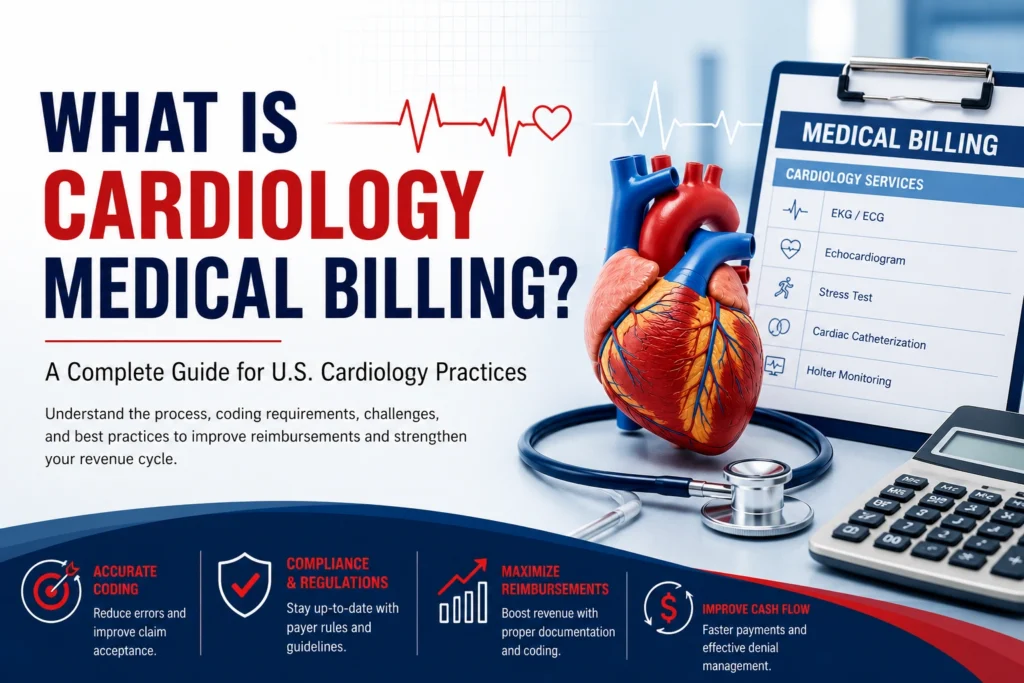
Cardiovascular disease remains one of the leading causes of hospitalization and healthcare spending in the United States. As cardiology practices continue to treat increasingly complex patient populations, maintaining financial stability has become just as important as delivering exceptional clinical care. This is where Cardiology Medical Billing plays a critical role.
Understanding What Is Cardiology Medical Billing is essential for cardiologists, practice administrators, healthcare executives, and revenue cycle leaders seeking to optimize reimbursements while remaining compliant with ever-changing payer regulations. Unlike primary care billing, cardiology billing involves specialized coding, complex procedures, extensive documentation requirements, and strict payer guidelines that directly impact revenue generation.
At Fine Claim LLC, we work with healthcare organizations across the United States to improve reimbursement outcomes through efficient Medical Billing Services and comprehensive Revenue Cycle Management Services. In this guide, we’ll explore everything healthcare providers need to know about cardiology medical billing, including its workflow, challenges, coding requirements, and proven strategies for maximizing revenue.
Understanding Cardiology Medical Billing
Cardiology medical billing is the process of translating cardiovascular healthcare services into billable claims that are submitted to insurance companies, Medicare, Medicaid, and other payers for reimbursement. The process involves documenting patient encounters, assigning diagnosis and procedure codes, submitting claims, managing denials, posting payments, and following up on outstanding balances.
Because cardiology encompasses a wide range of diagnostic, non-invasive, invasive, and interventional procedures, billing professionals must possess specialized knowledge of cardiovascular coding guidelines and payer policies.
From routine electrocardiograms to advanced cardiac catheterization procedures, every service must be accurately documented and coded to support medical necessity and ensure proper reimbursement.
For many providers, partnering with experienced Cardiology Medical Billing Services helps reduce administrative burden while improving financial performance.
Why Cardiology Billing Is More Complex Than General Medical Billing
Cardiology is among the most sophisticated specialties in healthcare, and its billing requirements reflect that complexity.
A single patient encounter may involve multiple diagnostic tests, physician interpretations, imaging studies, and follow-up services. Each component requires proper coding and documentation.
For example, a patient presenting with chest pain may undergo an electrocardiogram, echocardiogram, stress test, and physician consultation during the same episode of care. Every service must be coded correctly while complying with payer-specific billing rules.
Additionally, cardiology providers frequently perform procedures involving advanced technology and expensive equipment. As a result, reimbursement accuracy becomes critical for maintaining profitability.
Strong Revenue Cycle Management processes help cardiology practices navigate these complexities while minimizing claim denials and payment delays.
How the Cardiology Billing Process Works
The cardiology billing cycle begins long before a claim is submitted.
The process starts with patient registration and insurance verification. Accurate demographic information and eligibility verification help prevent billing errors later in the revenue cycle.
Once services are rendered, physicians document patient symptoms, diagnoses, treatment plans, test results, and procedures performed. Documentation must clearly support medical necessity and coding accuracy.
Next, certified coders review clinical documentation and assign appropriate diagnosis and procedure codes. Claims are then generated and electronically submitted to insurance payers.
After submission, claims undergo adjudication. Approved claims are reimbursed, while denied claims require correction and resubmission.
An effective Denial Management strategy ensures denied claims are resolved quickly, reducing revenue leakage and improving cash flow.
Key Coding Systems Used in Cardiology Medical Billing
Accurate coding is the foundation of successful cardiology reimbursement.
The first coding system used is ICD-10-CM, which identifies patient diagnoses and medical conditions. Common cardiology diagnoses include coronary artery disease, atrial fibrillation, hypertension, heart failure, and cardiac arrhythmias.
Procedure coding is performed using CPT codes developed by the American Medical Association (AMA). These codes describe diagnostic tests, physician services, and cardiovascular procedures.
Examples of commonly used cardiology CPT codes include electrocardiograms, echocardiography studies, stress testing, Holter monitoring, and cardiac catheterization procedures.
Healthcare providers can access official coding guidance through the American Medical Association (AMA) website, which serves as an authoritative resource for CPT coding updates.
Additionally, HCPCS codes may be required for certain supplies, medications, and equipment used during cardiovascular treatments.
Maintaining coding accuracy through specialized Medical Coding Services helps practices improve clean claim rates and reduce reimbursement delays.
Common Cardiology Procedures That Require Specialized Billing
Cardiology practices perform a wide variety of services that require detailed billing expertise.
Diagnostic cardiology services often include electrocardiograms, stress tests, echocardiograms, vascular ultrasound studies, and ambulatory cardiac monitoring.
Interventional cardiologists perform more advanced procedures such as angioplasty, stent placement, coronary angiography, and cardiac catheterization.
Electrophysiologists specialize in rhythm disorders and may perform pacemaker implantation, defibrillator placement, catheter ablations, and electrophysiology studies.
Each procedure carries unique coding requirements and reimbursement rules. Errors in documentation or coding can result in denied claims, underpayments, or compliance risks.
This is why many organizations invest in specialized Healthcare Revenue Cycle Management solutions designed specifically for cardiovascular practices.
Common Challenges in Cardiology Medical Billing
Cardiology practices face several reimbursement challenges that can negatively impact financial performance.
One of the most common issues involves documentation deficiencies. Incomplete physician notes often fail to support medical necessity requirements established by commercial insurers and government payers.
Another challenge is the constant evolution of coding guidelines. Regulatory changes, payer policy updates, and annual coding revisions require ongoing education for billing and coding teams.
Prior authorization requirements also present significant obstacles. Many advanced imaging studies and cardiovascular procedures require pre-approval before services can be rendered.
Claim denials related to authorization errors continue to be a major source of lost revenue for healthcare organizations nationwide.
Additionally, bundled payment rules and National Correct Coding Initiative edits create complexities that require specialized expertise.
Regular Revenue Cycle Audits help identify these vulnerabilities before they affect reimbursement performance.
The Importance of Denial Management in Cardiology
Denials represent one of the largest threats to revenue integrity within cardiology practices.
Claims may be denied for various reasons, including coding inaccuracies, documentation issues, eligibility problems, modifier errors, and authorization deficiencies.
Without an organized denial management process, denied claims can quickly accumulate and create significant accounts receivable challenges.
Successful cardiology practices implement proactive Denial Prevention Strategies to identify trends and address root causes before claims are submitted.
By tracking denial patterns and continuously improving workflows, providers can increase first-pass claim acceptance rates and accelerate cash collections.
Organizations that prioritize denial management often experience measurable improvements in overall revenue cycle performance.
Compliance and Regulatory Considerations
Cardiology billing must comply with numerous federal and payer-specific regulations.
Medicare remains one of the largest payers for cardiovascular services in the United States. Therefore, providers must follow guidance published by the Centers for Medicare & Medicaid Services (CMS).
CMS establishes rules regarding medical necessity, documentation standards, coding compliance, and reimbursement methodologies.
Failure to comply with regulatory requirements can result in audits, payment recoupments, penalties, and reputational damage.
Strong compliance programs, regular staff training, and ongoing monitoring are essential components of effective cardiology billing operations.
Partnering with experienced Revenue Cycle Management Services providers can help organizations maintain compliance while optimizing reimbursement outcomes.
How Technology Improves Cardiology Billing Performance
Technology has transformed modern healthcare billing operations.
Advanced billing software automates eligibility verification, charge capture, coding validation, claim scrubbing, and payment posting.
Artificial intelligence tools can identify potential coding issues before claims are submitted, helping providers reduce denials and improve accuracy.
Electronic health records streamline documentation workflows and improve communication between clinical and billing teams.
Many cardiology practices are also adopting Healthcare Revenue Cycle Automation solutions that accelerate claims processing and reduce administrative costs.
These innovations enable providers to focus more on patient care while improving financial efficiency.
Why U.S. Cardiology Practices Outsource Billing Services
Many cardiology groups across the United States choose to outsource their billing operations to specialized revenue cycle partners.
Outsourcing provides access to experienced coding professionals, dedicated accounts receivable specialists, denial management experts, and advanced billing technology.
Rather than managing staffing challenges internally, providers can leverage external expertise to improve collections and operational performance.
At Fine Claim LLC, we help healthcare organizations strengthen their financial health through customized Medical Billing Services, specialized Cardiology Medical Billing Services, and end-to-end Revenue Cycle Management Services tailored to the unique needs of cardiovascular practices.
By outsourcing complex billing functions, providers often achieve higher reimbursement rates, lower denial percentages, and improved cash flow.
FAQ
What is cardiology medical billing?
Cardiology medical billing is the process of submitting and managing insurance claims for cardiovascular healthcare services. It includes coding diagnoses and procedures, verifying insurance coverage, submitting claims, managing denials, and collecting reimbursements for services such as ECGs, echocardiograms, stress tests, cardiac catheterizations, and other heart-related treatments.
Why is cardiology medical billing more complex than general medical billing?
Cardiology medical billing is more complex because cardiovascular care involves specialized procedures, advanced diagnostic testing, detailed documentation requirements, and strict payer guidelines. Accurate coding and compliance are essential to avoid claim denials and maximize reimbursements.
What codes are used in cardiology medical billing?
Cardiology medical billing primarily uses ICD-10 codes for diagnoses, CPT codes for procedures and physician services, and HCPCS codes for certain supplies and services. Proper code selection helps ensure accurate reimbursement and regulatory compliance.
What are the most common cardiology billing procedures?
Common cardiology billing procedures include electrocardiograms (ECGs), echocardiograms, cardiac stress tests, Holter monitoring, cardiac catheterizations, angiography, pacemaker implantation, and electrophysiology studies. Each procedure has unique coding and documentation requirements.
What causes claim denials in cardiology billing?
Claim denials in cardiology billing are commonly caused by coding errors, incomplete documentation, missing prior authorizations, incorrect modifiers, eligibility issues, and lack of medical necessity documentation. Effective denial management helps recover lost revenue and reduce future denials.
How does revenue cycle management improve cardiology practice revenue?
Revenue Cycle Management (RCM) improves cardiology practice revenue by streamlining patient registration, insurance verification, coding, claim submission, payment posting, and denial management. A strong RCM strategy helps increase collections, reduce accounts receivable days, and improve cash flow.
Why is accurate medical coding important in cardiology billing?
Accurate medical coding ensures that cardiovascular services are properly documented and reimbursed. Correct coding reduces claim denials, supports compliance with payer regulations, and helps cardiology practices receive maximum reimbursement for services rendered.
Conclusion
Understanding What Is Cardiology Medical Billing is crucial for healthcare providers seeking to thrive in today’s increasingly complex reimbursement environment. Cardiology billing involves much more than claim submission—it requires specialized coding expertise, detailed documentation, compliance oversight, denial management, and strategic revenue cycle optimization.
As cardiovascular services continue to evolve, practices must adopt proactive billing strategies to protect revenue and maintain operational efficiency. Whether through enhanced internal processes or partnership with an experienced organization like Fine Claim LLC, investing in effective Revenue Cycle Management, Medical Coding Services, and Denial Management solutions can significantly improve financial outcomes.
For U.S. cardiology practices, accurate billing is not simply an administrative function—it is a critical component of long-term success, patient access, and sustainable growth.