
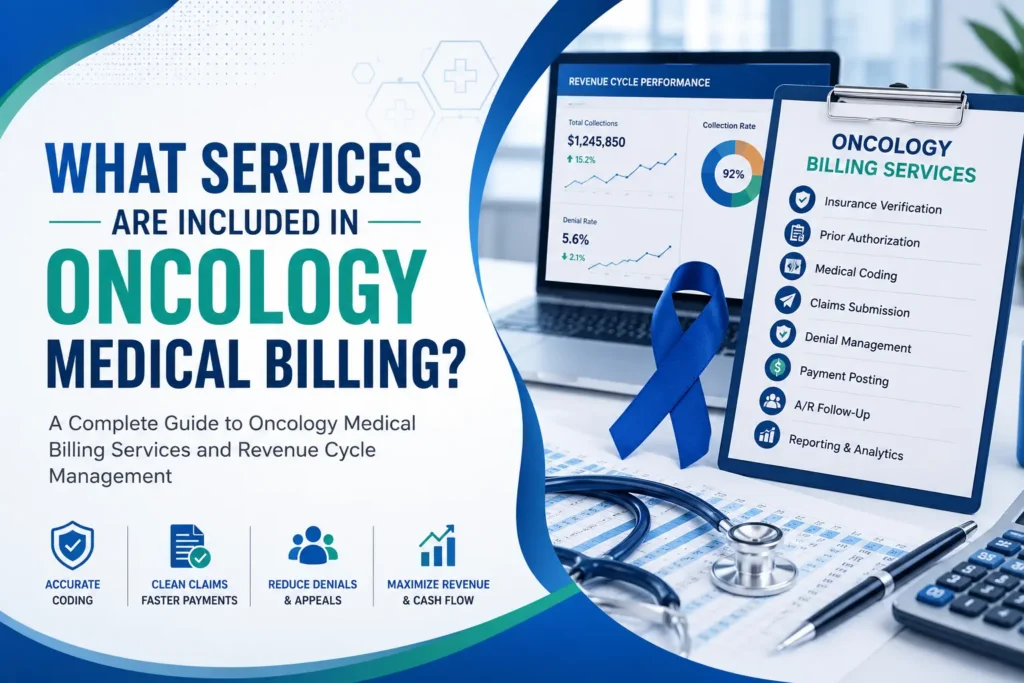
Cancer treatment is among the most complex specialties in modern healthcare. Oncology practices manage chemotherapy, immunotherapy, radiation therapy, laboratory testing, infusion services, surgeries, and ongoing patient monitoring. Every encounter generates multiple billable services that must be accurately documented, coded, and submitted to insurance payers.
Even a minor coding error or missing documentation can result in denied claims, delayed reimbursements, compliance risks, and lost revenue. That is why oncology medical billing requires specialized expertise rather than a standard medical billing approach.
At Fine Claim LLC, we understand the financial and operational challenges oncology providers face. Our experienced billing specialists help cancer centers, infusion clinics, hospital-based oncology departments, and independent oncology practices maximize reimbursement while maintaining compliance with payer regulations.
In this guide, we’ll explain what services are included in oncology medical billing, why each service matters, and how outsourcing can improve your practice’s financial performance.
What Is Oncology Medical Billing?
Oncology medical billing is the specialized process of translating cancer care services into accurate insurance claims while ensuring compliance with payer guidelines and federal healthcare regulations.
Unlike many specialties, oncology billing involves:
- Chemotherapy administration
- Radiation oncology
- Medical oncology
- Surgical oncology
- Immunotherapy
- Targeted therapy
- Infusion services
- Diagnostic laboratory testing
- Pathology services
- High-cost specialty medications
Because cancer treatments often continue over months or years, billing professionals must coordinate multiple claims across different insurance plans while accurately documenting every stage of treatment.
Why Oncology Billing Is More Complex Than Other Specialties
Cancer treatment is highly individualized. Two patients with the same diagnosis may receive completely different treatment plans depending on cancer stage, genetic testing, insurance coverage, and physician recommendations.
This creates several billing challenges, including:
- Frequent prior authorization requirements
- Multiple providers involved in care
- Expensive injectable medications
- Drug wastage reporting
- Time-based infusion coding
- Complex CPT, HCPCS, and ICD-10-CM coding
- Medicare and commercial payer policy variations
- Extensive documentation requirements
Missing any of these details can significantly impact reimbursement.
Services Included in Oncology Medical Billing
Professional oncology billing is much more than claim submission. It is a comprehensive revenue cycle management process that begins before the patient receives treatment and continues until every dollar is collected.
Insurance Verification and Benefits Eligibility
One of the first services included in oncology billing is verifying the patient’s insurance coverage.
Billing specialists confirm:
- Active insurance eligibility
- Deductibles
- Coinsurance
- Copay responsibilities
- Out-of-pocket maximums
- Referral requirements
- Network participation
Early verification helps prevent treatment delays and unexpected patient balances.
Prior Authorization Management
Many chemotherapy drugs, biologics, immunotherapy treatments, imaging studies, and specialty medications require payer approval before treatment begins.
Prior authorization specialists:
- Submit clinical documentation
- Coordinate with physicians
- Monitor authorization status
- Appeal authorization denials
- Track authorization expiration dates
Proper authorization significantly reduces claim denials.
Accurate Oncology Medical Coding
Coding is one of the most critical components of oncology billing.
Certified coders assign appropriate:
- ICD-10 diagnosis codes
- CPT procedure codes
- HCPCS Level II drug codes
- Infusion administration codes
- Drug wastage modifiers
- Evaluation and Management (E/M) codes
Accurate coding ensures compliance while maximizing reimbursement.
For coding guidance, providers frequently reference the American Medical Association (AMA) CPT® resources and the Centers for Medicare & Medicaid Services (CMS) coding policies.
Charge Entry and Charge Capture
Every oncology encounter generates numerous billable charges.
These may include:
- Office visits
- Chemotherapy administration
- Drug administration
- Infusion time
- Radiation therapy
- Laboratory testing
- Imaging services
- Pharmacy charges
Billing professionals ensure every service performed is accurately entered into the billing system.
Missing even one charge can reduce practice revenue.
Chemotherapy Billing
Chemotherapy billing requires extensive knowledge of payer-specific rules.
Billing specialists accurately report:
- Initial infusion
- Sequential infusion
- Concurrent infusion
- Push injections
- Hydration therapy
- Drug dosage
- Units administered
- Drug wastage
- National Drug Codes (NDC)
Since chemotherapy medications are expensive, billing errors can have substantial financial consequences.
Immunotherapy and Biologic Drug Billing
Modern cancer care increasingly relies on biologics and immunotherapy medications.
Billing professionals verify:
- HCPCS drug codes
- Correct dosage units
- Medical necessity
- Documentation requirements
- Payer-specific reimbursement policies
These medications often require additional documentation because of their high cost.
Radiation Oncology Billing
Radiation oncology services involve separate billing processes that include:
- Simulation
- Treatment planning
- Dosimetry
- Treatment delivery
- Image guidance
- Weekly treatment management
- Follow-up visits
Each service has unique coding and documentation requirements.
Claims Submission
After coding and charge entry, claims are electronically submitted to Medicare, Medicaid, and commercial insurance companies.
Professional billing teams:
- Validate claims
- Identify missing information
- Correct coding edits
- Ensure HIPAA-compliant transmission
- Monitor claim acceptance
Clean claims improve first-pass acceptance rates and accelerate reimbursement.
Payment Posting
Once insurance companies process claims, payments are accurately posted into the practice management system.
Payment posting includes:
- Insurance payments
- Patient payments
- Electronic Remittance Advice (ERA)
- Adjustment posting
- Contractual allowance reconciliation
Accurate posting helps identify underpayments quickly.
Denial Management and Appeals
Claim denials are common in oncology because of complex treatment plans and payer policies.
Denial specialists investigate:
- Medical necessity denials
- Authorization issues
- Coding errors
- Eligibility problems
- Missing documentation
- Drug billing discrepancies
They prepare appeals with supporting documentation to recover lost revenue.
According to CMS, proactive denial prevention and documentation improvement are essential components of effective revenue cycle management.
Accounts Receivable (A/R) Follow-Up
Outstanding insurance balances require continuous monitoring.
A/R specialists:
- Contact insurance companies
- Resolve payment delays
- Correct rejected claims
- Rebill when necessary
- Escalate unresolved balances
Consistent follow-up reduces aging accounts and improves cash flow.
Patient Billing and Collections
Cancer treatment often results in significant patient financial responsibility.
Billing teams generate:
- Patient statements
- Payment plans
- Financial counseling support
- Collection follow-up
- Payment reconciliation
Transparent communication improves the patient experience while increasing collections.
Compliance and Regulatory Monitoring
Healthcare regulations change frequently.
Oncology billing specialists stay updated with:
- HIPAA regulations
- Medicare billing policies
- OIG compliance guidance
- National Correct Coding Initiative (NCCI)
- Local Coverage Determinations (LCDs)
Compliance helps reduce audit risks and protects practice revenue.
Additional compliance resources are available through the Office of Inspector General (OIG).
Revenue Cycle Reporting and Analytics
Comprehensive reporting enables oncology practices to make informed financial decisions.
Typical reports include:
- Collection trends
- Denial rates
- Days in A/R
- First-pass claim acceptance
- Net collection rate
- Payer performance
- Revenue by provider
- Procedure utilization
These insights help practices identify opportunities for revenue improvement.
Technology Used in Oncology Medical Billing
Today’s oncology billing relies on advanced technology to improve efficiency and accuracy.
Many billing companies use:
- Electronic Health Records (EHR)
- Practice Management Software
- Electronic Claims Clearinghouses
- Automated eligibility verification
- AI-assisted coding support
- Revenue cycle analytics dashboards
Technology helps reduce manual errors while speeding up reimbursement.
Common Oncology Billing Challenges
Even experienced practices encounter billing obstacles because oncology treatments involve multiple providers, evolving payer rules, and expensive medications.
Some of the most common challenges include inaccurate infusion coding, missing prior authorizations, underpaid drug reimbursements, incomplete documentation, frequent coding updates, delayed insurance responses, and high denial rates. These issues can interrupt cash flow and increase administrative burden if not addressed promptly.
A dedicated oncology billing partner helps practices overcome these challenges through continuous claim monitoring, payer follow-up, and regulatory compliance.
Why Outsource Oncology Medical Billing?
Many oncology providers choose to outsource billing because maintaining an in-house billing department requires ongoing training, staffing, and technology investments.
Outsourcing provides several advantages:
- Improved claim accuracy
- Faster reimbursements
- Lower denial rates
- Reduced administrative workload
- Certified coding expertise
- Better compliance monitoring
- Scalable billing support
- Detailed financial reporting
Instead of spending valuable time managing billing operations, providers can focus on delivering exceptional patient care.
Why Choose Fine Claim LLC?
At Fine Claim LLC, we provide end-to-end oncology medical billing solutions designed specifically for the complexity of cancer care. Our experienced billing professionals understand payer requirements, oncology coding guidelines, infusion billing, prior authorizations, and revenue cycle optimization.
Our services include insurance verification, medical coding, charge posting, claims submission, payment posting, denial management, accounts receivable follow-up, compliance support, and detailed financial reporting. We work closely with oncology practices across the United States to improve operational efficiency, reduce claim denials, and maximize reimbursement.
Whether you operate an independent oncology clinic, infusion center, or hospital-based cancer program, Fine Claim LLC delivers customized billing solutions that support sustainable financial growth while maintaining the highest standards of compliance and accuracy.
Frequently Asked Questions
What services are included in oncology medical billing?
Oncology medical billing includes insurance verification, prior authorization, medical coding, charge entry, chemotherapy billing, infusion billing, claims submission, payment posting, denial management, accounts receivable follow-up, patient billing, compliance monitoring, and revenue cycle reporting.
Why is oncology billing different from general medical billing?
Oncology billing involves complex drug administration, infusion coding, high-cost medications, prior authorizations, multiple treatment modalities, and specialized payer guidelines that require advanced coding and billing expertise.
What are common reasons for oncology claim denials?
Common denial reasons include missing prior authorizations, incorrect CPT or HCPCS codes, insufficient documentation, medical necessity issues, eligibility problems, and billing errors related to chemotherapy or infusion services.
How can outsourcing oncology medical billing improve revenue?
Outsourcing improves coding accuracy, reduces claim denials, accelerates reimbursements, strengthens compliance, enhances accounts receivable management, and allows providers to focus on patient care instead of administrative tasks.
Does oncology billing require certified medical coders?
Yes. Because oncology services involve complex coding, certified medical coders with specialty experience help ensure accurate claim submission, compliance, and optimal reimbursement.
Conclusion
Oncology medical billing is one of the most specialized areas of healthcare revenue cycle management. From insurance verification and prior authorizations to chemotherapy coding, claims submission, denial management, and accounts receivable follow-up, every step requires precision, regulatory knowledge, and ongoing attention to payer requirements.
Partnering with an experienced billing company like Fine Claim LLC helps oncology practices reduce administrative burden, improve reimbursement accuracy, maintain compliance, and strengthen financial performance. With expert support and a comprehensive billing strategy, providers can devote more time to what matters most—delivering exceptional care to patients throughout their cancer treatment journey.