
The healthcare industry is becoming increasingly complex. Rising operational costs, changing payer regulations, staffing shortages, evolving insurance policies, and stricter compliance requirements have made financial management more challenging than ever before. While healthcare providers focus on delivering exceptional patient care, maintaining a healthy financial foundation is equally important for long-term success.
This is where Revenue Cycle Management (RCM) plays a critical role. From the moment a patient schedules an appointment until the final payment is collected, every administrative and financial process impacts the overall profitability of a healthcare organization. Without an efficient revenue cycle, even the most successful medical practice can experience delayed reimbursements, increased claim denials, cash flow issues, and administrative burdens.
Understanding why revenue cycle management is important in the healthcare industry helps providers recognize that RCM is more than just billing—it’s a strategic process that improves operational efficiency, enhances patient satisfaction, and ensures financial sustainability.
At Fine Claim LLC, we help healthcare providers across the United States optimize every stage of their revenue cycle, enabling them to increase collections while delivering better patient experiences.
What Is Revenue Cycle Management?
Revenue Cycle Management (RCM) is the complete financial process that healthcare organizations use to manage patient revenue from the initial appointment through final payment collection.
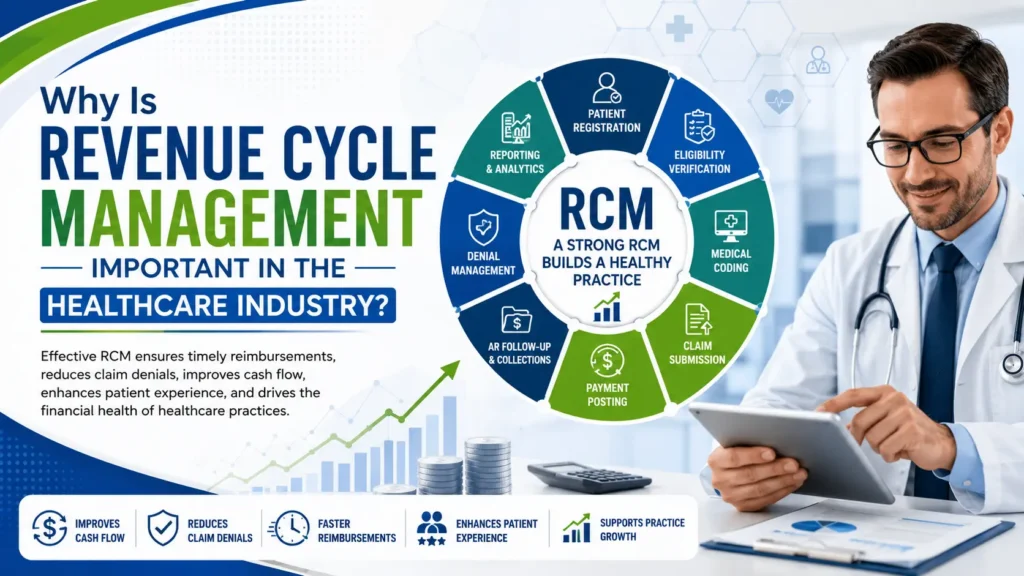
The revenue cycle includes patient registration, insurance eligibility verification, medical coding, charge capture, claim submission, payment posting, denial management, accounts receivable follow-up, and patient billing.
Every stage of the cycle directly influences reimbursement accuracy and practice profitability. Even a small error during registration or coding can result in claim denials, payment delays, or lost revenue.
Healthcare organizations that invest in efficient Revenue Cycle Management Services experience stronger financial performance while minimizing administrative inefficiencies.
Why Revenue Cycle Management Is Important in the Healthcare Industry
Healthcare organizations generate revenue only when services provided are accurately documented, properly coded, submitted to insurance companies, and reimbursed without unnecessary delays.
A well-managed revenue cycle creates financial stability while allowing physicians and healthcare staff to focus on patient care instead of administrative challenges.
Efficient Healthcare Revenue Cycle Management ensures that providers receive timely reimbursements, maintain healthy cash flow, reduce bad debt, and improve operational performance across the organization.
As healthcare reimbursement models continue evolving in the United States, revenue cycle optimization has become a necessity rather than an option.
Improves Cash Flow and Financial Stability
One of the biggest reasons revenue cycle management is important is its direct impact on cash flow.
Healthcare organizations rely on predictable reimbursement to pay employees, purchase medical equipment, invest in technology, and expand patient services.
When claims remain unpaid or are delayed because of billing errors, missing documentation, or eligibility issues, the practice experiences unnecessary financial stress.
An optimized Medical Billing Services process ensures claims are submitted correctly the first time, significantly reducing reimbursement delays and maintaining consistent revenue.
Healthcare organizations with strong RCM processes can forecast revenue more accurately and make better financial decisions throughout the year.
Reduces Claim Denials
Claim denials are among the largest sources of revenue loss for healthcare providers.
Insurance companies deny claims for numerous reasons, including:
- Incorrect medical coding
- Missing documentation
- Eligibility verification errors
- Duplicate claims
- Authorization issues
- Timely filing limitations
An effective revenue cycle identifies these issues before claims are submitted.
Using advanced claim scrubbing tools, experienced coders, and proactive quality checks, healthcare organizations can significantly improve their first-pass claim acceptance rates.
A lower denial rate translates directly into higher collections and reduced administrative costs.
Healthcare providers that prioritize Denial Management Services recover more revenue while preventing recurring billing errors.
Accelerates Insurance Reimbursements
Every delayed payment affects the financial health of a healthcare organization.
Revenue cycle management streamlines every step involved in insurance billing, helping providers receive reimbursements faster.
Accurate coding, electronic claim submission, payer-specific compliance, and continuous claim monitoring reduce processing time and improve payment turnaround.
Instead of waiting months for reimbursement, providers can maintain healthier cash flow through proactive revenue cycle optimization.
This becomes especially valuable for specialty practices with high claim volumes.
Improves Patient Financial Experience
Modern healthcare extends beyond clinical care.
Patients increasingly expect transparent billing, accurate insurance estimates, convenient payment options, and clear communication regarding financial responsibilities.
A well-managed revenue cycle provides accurate patient statements, flexible payment plans, and fewer billing disputes.
When patients understand their financial obligations before receiving treatment, satisfaction improves while collection rates increase.
Positive billing experiences also strengthen patient loyalty and trust.
Enhances Operational Efficiency
Administrative inefficiencies consume valuable staff time and reduce productivity.
Manual billing processes often involve repetitive data entry, paper documentation, claim corrections, and extensive follow-up.
Efficient Healthcare Revenue Cycle Management automates many administrative workflows, allowing staff to focus on higher-value tasks.
Automation supports:
- Electronic eligibility verification
- Digital claim submission
- Automated payment posting
- Real-time reporting
- Denial tracking
- Accounts receivable monitoring
These improvements reduce operational costs while increasing overall productivity.
Strengthens Compliance with Healthcare Regulations
Healthcare providers must comply with evolving regulations established by the Centers for Medicare & Medicaid Services (CMS) and maintain accurate documentation and coding practices aligned with guidance from the American Medical Association (AMA). Staying informed about these standards helps reduce compliance risks and supports timely reimbursements.
Supports Better Medical Coding Accuracy
Certified coding professionals continuously follow updates published by the American Academy of Professional Coders (AAPC) to ensure ICD-10, CPT, and HCPCS codes are assigned correctly. Accurate coding not only improves reimbursement but also minimizes audit risks and payer disputes.
Reduces Accounts Receivable Aging
Outstanding accounts receivable reduce available cash and increase collection challenges.
The longer claims remain unpaid, the lower the probability of successful collection.
Revenue cycle management actively monitors unpaid claims, prioritizes aging accounts, identifies payer issues, and performs timely follow-up.
Effective Accounts Receivable Management shortens collection cycles while improving overall recovery rates.
Organizations with lower AR aging maintain healthier financial performance and stronger operational stability.
Provides Actionable Financial Insights
Many healthcare organizations benchmark their financial performance using best practices and industry reports from the Healthcare Financial Management Association (HFMA) and operational guidance provided by the Medical Group Management Association (MGMA). These resources help practices monitor KPIs and improve overall revenue cycle efficiency.
Key performance indicators include:
- Net collection rate
- Days in accounts receivable
- Clean claim rate
- First-pass acceptance rate
- Denial percentage
- Average reimbursement time
- Patient payment trends
These analytics help identify financial weaknesses before they become significant problems.
Healthcare leaders can continuously improve revenue performance using accurate operational data.
Supports Practice Growth
A financially healthy practice is better positioned for expansion.
Whether opening new locations, hiring physicians, investing in technology, or adding specialty services, sustainable growth requires predictable revenue.
Efficient revenue cycle management provides the financial stability needed for long-term success.
Providers can confidently invest in patient care improvements knowing their reimbursement process is optimized.
Why Healthcare Providers Outsource Revenue Cycle Management
Many hospitals, physician groups, specialty clinics, and private practices outsource revenue cycle management to experienced billing companies.
Outsourcing provides access to certified billing specialists, advanced technology, industry expertise, and scalable solutions without increasing internal staffing costs.
Professional RCM partners continuously monitor payer updates, regulatory changes, coding revisions, and reimbursement trends to maximize collections.
This allows healthcare providers to spend more time caring for patients while revenue experts manage complex billing operations.
Organizations that outsource frequently experience improved clean claim rates, faster reimbursements, reduced denials, and stronger overall financial performance.
How Fine Claim LLC Helps Healthcare Providers Improve Revenue Cycle Performance
At Fine Claim LLC, we deliver comprehensive Revenue Cycle Management Services designed specifically for healthcare providers across the United States.
Our experienced billing professionals manage every stage of the revenue cycle, including insurance eligibility verification, medical coding, charge posting, claim submission, payment posting, denial management, accounts receivable follow-up, and reimbursement optimization.
By combining experienced professionals, proven workflows, and advanced billing technology, we help practices reduce administrative burdens while improving financial outcomes.
Whether you operate an independent physician practice, specialty clinic, urgent care center, behavioral health practice, or multi-location healthcare organization, Fine Claim LLC provides customized revenue cycle solutions that improve efficiency, maximize reimbursements, and support long-term growth.
The Future of Revenue Cycle Management
Healthcare reimbursement continues evolving as artificial intelligence, predictive analytics, automation, and value-based care reshape financial operations.
Future-ready revenue cycle management will rely more heavily on intelligent automation, real-time eligibility verification, automated coding assistance, predictive denial prevention, and advanced revenue analytics.
Healthcare organizations that adopt modern revenue cycle strategies today will be better prepared to remain financially competitive tomorrow.
Investing in revenue cycle optimization is no longer simply about improving collections—it is about building a resilient healthcare organization capable of adapting to continuous industry change.
Conclusion
Understanding why revenue cycle management is important in the healthcare industry is essential for every healthcare provider seeking long-term financial success. An efficient revenue cycle strengthens cash flow, minimizes claim denials, improves reimbursement speed, supports regulatory compliance, enhances patient satisfaction, and creates opportunities for sustainable growth.
As the U.S. healthcare landscape becomes increasingly complex, partnering with an experienced revenue cycle management company can make a significant difference in financial performance.
Fine Claim LLC is committed to helping healthcare providers optimize every stage of the revenue cycle with customized solutions that increase efficiency, maximize reimbursements, and reduce administrative burdens. By investing in expert revenue cycle management today, healthcare organizations can focus on what matters most—delivering exceptional patient care while maintaining a strong financial future.