
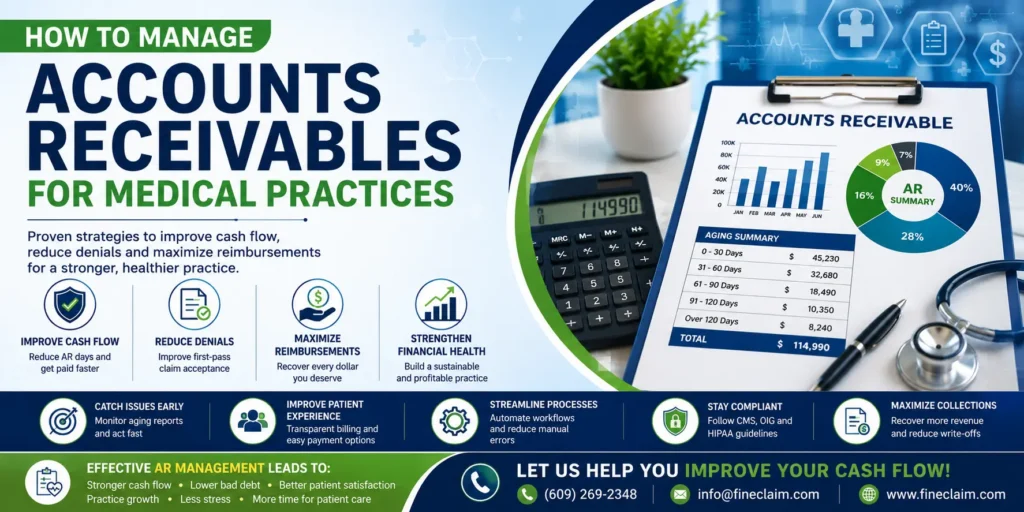
For medical practices across the United States, providing exceptional patient care is only one part of running a successful healthcare organization. Equally important is maintaining a healthy revenue cycle that ensures providers receive timely reimbursement for the services they deliver. Unfortunately, delayed insurance payments, claim denials, patient balances, and administrative inefficiencies often lead to growing accounts receivable (AR), creating unnecessary financial stress.
Understanding how to manage accounts receivables for medical practices has become more important than ever as healthcare reimbursement continues to evolve. Insurance regulations frequently change, patient financial responsibility continues to increase, and providers must navigate complex payer requirements while maintaining compliance with federal guidelines. Without a structured AR management process, even high-performing medical practices can experience cash flow disruptions that affect staffing, operations, and long-term growth.
At Fine Claim LLC, we help physicians, specialty clinics, hospitals, and healthcare organizations throughout the United States improve their financial performance through efficient Revenue Cycle Management Services. Our team combines advanced billing technology, experienced revenue cycle specialists, and proactive follow-up strategies to reduce outstanding receivables, recover unpaid claims, and accelerate reimbursements.
This guide explains the fundamentals of medical accounts receivable management, why it matters, and the strategies every healthcare provider should implement to maintain a financially healthy practice.
What Is Accounts Receivable in Medical Billing?
Accounts receivable (AR) in medical billing represents the total amount of money owed to a healthcare provider for medical services that have already been provided but not yet paid by insurance companies or patients. Once a claim is submitted, the outstanding balance remains in accounts receivable until payment is received, adjusted, or written off according to payer contracts.
Effective AR management is much more than collecting overdue payments. It involves monitoring every claim throughout the reimbursement process, identifying payment delays, resolving denials quickly, following up with insurance carriers, and ensuring patient balances are collected efficiently.
Healthcare organizations that actively monitor their receivables typically experience stronger cash flow, fewer write-offs, and improved financial stability compared to practices that only address aging claims after significant delays.
Medical practices should also stay informed about reimbursement regulations and payer policies published by the Centers for Medicare & Medicaid Services (CMS), which establishes billing guidelines, Medicare payment rules, and compliance requirements followed by providers throughout the United States. These guidelines help practices reduce claim errors while maintaining regulatory compliance.
Many providers choose to partner with experts offering Accounts Receivable in Medical Billing Services to improve collection rates, reduce aging balances, and strengthen overall revenue cycle performance.
Why Accounts Receivable Management Is Critical for Medical Practices
Healthcare organizations depend on consistent reimbursement to support daily operations, including payroll, medical equipment, technology investments, facility expenses, compliance initiatives, and ongoing patient care. When outstanding receivables continue to grow, practices often face financial challenges despite maintaining a busy patient schedule.
Poor AR management can result in delayed insurance payments, increasing claim denials, rising administrative costs, higher bad debt, and reduced profitability. It may also force providers to spend valuable clinical time resolving billing issues instead of focusing on patient care.
A well-managed accounts receivable process provides numerous operational and financial benefits. Practices experience improved cash flow, faster reimbursement cycles, lower denial rates, increased collection percentages, and stronger financial forecasting. Effective AR management also improves patient satisfaction by creating a transparent and organized billing experience.
For healthcare organizations seeking long-term financial stability, integrating AR management into a comprehensive Healthcare Revenue Cycle Management strategy is essential.
The Medical Accounts Receivable Lifecycle
Successfully managing accounts receivables begins well before an insurance claim is submitted. Every step of the revenue cycle directly impacts how quickly providers receive payment.
The process starts with accurate patient registration and comprehensive Eligibility Verification Services. Verifying insurance coverage before appointments reduces eligibility-related denials, minimizes billing errors, and helps patients understand their financial responsibility before receiving care.
After eligibility verification, providers must ensure complete clinical documentation that accurately reflects the services performed. Proper documentation supports compliant coding and helps justify medical necessity during payer review.
The next phase involves accurate Medical Coding Services, where certified coders assign ICD-10-CM, CPT, and HCPCS codes based on physician documentation. Coding accuracy is one of the most important factors affecting reimbursement. Healthcare providers should remain current with coding updates published by the American Medical Association (AMA) for CPT coding guidance and educational resources provided by AAPC, one of the nation’s leading medical coding organizations. Following these industry standards significantly improves clean claim rates while reducing preventable coding errors.
Once coding is complete, claims move through Charge Posting Services, where billable services are accurately entered into the billing system before electronic claim submission. Claims should undergo automated claim scrubbing to identify missing information, coding inconsistencies, or payer-specific issues before transmission.
After submission, insurance companies review each claim and either approve payment, request additional documentation, reject the claim, or issue a denial. Practices that actively monitor claim status can quickly identify payment delays and initiate follow-up before claims enter advanced aging categories.
Finally, insurance payments are accurately recorded through Payment Posting Services, allowing billing teams to identify remaining patient balances, contractual adjustments, underpayments, or unpaid claims requiring additional action.
Every phase of this lifecycle directly influences accounts receivable performance. Small errors made during registration, coding, documentation, or claim submission often create significant reimbursement delays later in the revenue cycle.
Healthcare organizations that establish standardized workflows across every stage generally experience fewer denials, lower AR days, and improved financial outcomes.
Understanding the Financial Impact of Poor AR Management
Many healthcare providers underestimate how quickly inefficient accounts receivable management can affect overall practice performance. A growing AR balance doesn’t simply represent delayed payments—it ties up working capital that could otherwise support staffing, technology upgrades, patient services, or practice expansion.
Outstanding claims older than 90 or 120 days become increasingly difficult to collect. Insurance filing deadlines, incomplete documentation, coding corrections, and patient payment delays all contribute to revenue leakage if not addressed promptly.
Regular financial reviews, supported by documentation best practices recommended by AHIMA (American Health Information Management Association), help healthcare organizations improve documentation quality, strengthen coding accuracy, and maintain consistent revenue cycle performance.
By combining proactive AR monitoring with experienced Medical Billing Services, practices can significantly improve reimbursement speed while reducing costly administrative burdens.
Proven Strategies to Manage Accounts Receivables for Medical Practices
Successfully managing accounts receivables requires more than simply following up on unpaid claims. It involves creating a proactive workflow that identifies reimbursement issues early, resolves claim problems quickly, and continuously monitors financial performance. Healthcare organizations that adopt a structured approach to AR management typically experience faster reimbursements, lower denial rates, and healthier cash flow.
Submit Clean Claims the First Time
The fastest way to improve accounts receivable performance is to prevent claim errors before submission. Every rejected or denied claim increases administrative costs and extends the payment cycle.
A clean claim contains accurate patient demographics, verified insurance information, complete provider documentation, correct diagnosis and procedure codes, appropriate modifiers, and payer-specific billing requirements. Even a small error can result in claim rejection or delayed reimbursement.
Healthcare providers should routinely reference coding updates from the American Medical Association (AMA) for CPT code guidance and rely on educational resources from AAPC to help billing teams stay current with annual coding changes and compliance requirements. Maintaining coding accuracy significantly improves first-pass acceptance rates and reduces preventable denials.
Practices that invest in professional Medical Coding Services consistently submit higher-quality claims, improving reimbursement speed while minimizing costly corrections.
Monitor AR Aging Reports Regularly
An AR aging report provides a clear picture of outstanding balances based on the length of time claims have remained unpaid. Rather than waiting until claims become severely overdue, billing teams should review aging reports every week.
Claims are commonly grouped into 0–30, 31–60, 61–90, 91–120, and over 120-day categories. As claims move into older aging buckets, the likelihood of successful reimbursement decreases significantly.
Monitoring aging reports allows practices to identify payer delays, recurring billing issues, underpayments, and collection bottlenecks before they become major financial problems.
Organizations using comprehensive Accounts Receivable in Medical Billing Services often maintain significantly lower aging balances because experienced AR specialists prioritize follow-up based on claim value and payer deadlines.
Strengthen Your Denial Management Process
Claim denials remain one of the largest contributors to growing accounts receivable balances. However, many denials are preventable when practices identify their root causes and implement corrective actions.
Common denial reasons include inaccurate patient information, insurance eligibility issues, missing prior authorization, coding mistakes, insufficient documentation, duplicate claims, and lack of medical necessity.
Instead of simply resubmitting denied claims, healthcare providers should analyze denial trends to determine why claims are being rejected repeatedly. Corrective actions may involve improving front-office workflows, enhancing provider documentation, updating coding practices, or providing additional staff training.
Practices should also stay informed about compliance recommendations published by the Office of Inspector General (OIG), which provides valuable guidance for reducing billing errors, preventing fraudulent billing practices, and maintaining healthcare compliance.
Partnering with specialists in Denial Management Services helps providers recover lost revenue while reducing future denial rates through continuous performance improvement.
Verify Insurance Eligibility Before Every Visit
Many reimbursement delays begin before the patient even arrives for an appointment.
Insurance coverage can change frequently due to policy updates, employment changes, eligibility limitations, or coordination of benefits. Failing to verify coverage often results in avoidable claim denials and delayed collections.
Implementing reliable Eligibility Verification Services before each patient visit allows practices to confirm active coverage, determine copays, identify deductibles, verify referral requirements, and obtain prior authorizations when necessary.
Accurate eligibility verification improves clean claim rates, reduces administrative rework, and creates a better financial experience for both providers and patients.
Improve Patient Collections
Patient financial responsibility continues to grow as high-deductible health plans become more common throughout the United States. As a result, patient collections now represent an increasingly important component of practice revenue.
Successful medical practices establish transparent financial policies before treatment begins. Patients should receive clear estimates of their expected financial responsibility, understand available payment options, and have convenient methods for paying balances.
Offering secure online payment portals, mobile payment options, automated payment reminders, digital statements, and flexible payment plans encourages faster collections while improving the patient experience.
Practices may also direct uninsured patients to HealthCare.gov to explore available health insurance options, helping reduce unexpected self-pay balances while improving access to healthcare coverage.
Effective patient communication reduces confusion, increases trust, and significantly improves collection rates.
Automate Routine Billing Processes
Technology has become one of the most valuable tools for improving accounts receivable management.
Modern practice management systems, electronic health records (EHR), automated claim scrubbing software, payment posting systems, denial tracking tools, and reporting dashboards allow billing teams to process claims more efficiently while reducing manual errors.
Automation helps practices:
- Reduce claim submission errors.
- Track outstanding claims in real time.
- Identify denied or rejected claims faster.
- Automate payment posting.
- Generate detailed AR reports.
- Prioritize high-value unpaid claims.
Rather than replacing experienced billing professionals, automation allows them to focus on complex reimbursement issues that require human expertise.
Healthcare organizations combining automation with experienced Revenue Cycle Management Services often achieve significantly better financial performance than practices relying solely on manual processes.
Follow Up with Insurance Companies Consistently
Submitting a claim does not guarantee timely payment. Insurance carriers frequently request additional documentation, delay claim processing, or issue partial reimbursements.
Successful AR management requires proactive payer communication.
Billing teams should routinely review claim status, contact insurance representatives regarding outstanding claims, submit corrected claims promptly, appeal inappropriate denials, and document every payer interaction.
Timely follow-up prevents claims from exceeding payer filing deadlines while increasing reimbursement success rates.
Healthcare providers should regularly review reimbursement updates published by the Centers for Medicare & Medicaid Services (CMS) because Medicare payment policies often influence reimbursement practices adopted by commercial insurers.
Conduct Routine Accounts Receivable Audits
Routine audits help identify hidden revenue leakage before it negatively impacts practice profitability.
Monthly AR reviews should evaluate:
- Outstanding claim balances.
- Denial trends.
- Average Days in AR.
- Payer turnaround times.
- Underpayment patterns.
- Collection rates.
- Payment posting accuracy.
- Write-off percentages.
Healthcare organizations should also compare their documentation practices with recommendations published by AHIMA (American Health Information Management Association) to strengthen documentation quality, improve coding accuracy, and support successful reimbursement.
Practices performing regular audits are better equipped to identify workflow inefficiencies and implement corrective actions before financial performance declines.
Consider Outsourcing Accounts Receivable Management
Managing accounts receivable internally can become increasingly difficult as claim volumes grow and reimbursement requirements become more complex.
Outsourcing allows healthcare providers to leverage experienced billing professionals who specialize in payer follow-up, denial resolution, appeals, payment posting, aging analysis, and reimbursement optimization.
At Fine Claim LLC, our dedicated AR specialists use advanced reporting tools, proven collection strategies, and payer-specific expertise to recover outstanding balances while reducing Days in AR. Our customized Medical Billing Services help practices improve cash flow, maximize reimbursements, and reduce administrative burdens without compromising compliance or patient satisfaction.
Whether you’re an independent physician practice, multi-specialty clinic, ambulatory surgery center, or hospital, outsourcing accounts receivable management can provide measurable improvements in revenue cycle performance while allowing your clinical team to focus on delivering exceptional patient care.
Best Practices for Long-Term Accounts Receivable Success
Managing accounts receivables successfully requires consistency rather than occasional follow-up. Medical practices that treat accounts receivable management as an ongoing financial strategy instead of a reactive task are more likely to maintain healthy cash flow and reduce revenue leakage.
One of the first best practices is establishing measurable Key Performance Indicators (KPIs). Healthcare organizations should regularly monitor Days in Accounts Receivable (Days in AR), Net Collection Rate, Gross Collection Rate, First-Pass Claim Acceptance Rate, Denial Rate, Clean Claim Rate, and the percentage of accounts aged over 90 days. These metrics provide valuable insight into billing performance and help identify reimbursement issues before they become significant financial problems.
Regular staff education is equally important. Insurance payer policies, coding guidelines, and reimbursement rules change frequently. Billing teams should receive ongoing training to remain current with updates published by the American Medical Association (AMA) for CPT coding standards and educational resources available through AAPC. Continuous learning helps reduce coding errors, improve claim accuracy, and increase first-pass payment rates.
Healthcare providers should also prioritize documentation quality. Complete and accurate clinical documentation supports proper coding, reduces denials, and strengthens reimbursement. Best practices recommended by AHIMA (American Health Information Management Association) can help organizations improve documentation integrity while maintaining compliance with healthcare regulations.
Compliance should never be overlooked. Regularly reviewing billing guidance from the Centers for Medicare & Medicaid Services (CMS) and compliance resources from the Office of Inspector General (OIG) helps medical practices stay aligned with federal regulations, reduce audit risks, and avoid costly billing mistakes.
Technology also plays a significant role in long-term AR success. Integrated practice management software, automated claim scrubbing, denial analytics, electronic payment posting, and reporting dashboards help billing teams identify outstanding claims faster and prioritize collection efforts. When combined with professional Revenue Cycle Management Services, these technologies create a more efficient reimbursement process while reducing manual work.
Finally, practices should schedule quarterly revenue cycle reviews to evaluate workflow efficiency, payer performance, denial trends, and collection strategies. Continuous improvement ensures billing processes evolve alongside changing healthcare regulations and payer requirements.
Why Choose Fine Claim LLC?
Managing accounts receivables has become increasingly challenging as healthcare reimbursement grows more complex. Insurance companies continually update billing requirements, patient financial responsibility continues to increase, and regulatory compliance remains a top priority for every healthcare provider.
Fine Claim LLC helps medical practices across the United States overcome these challenges through customized Medical Billing Services and comprehensive Accounts Receivable in Medical Billing Services.
Our experienced revenue cycle professionals proactively monitor unpaid claims, communicate with insurance carriers, resolve denials, identify underpayments, post payments accurately, and recover outstanding balances before they negatively affect your cash flow.
Our solutions include:
- Revenue Cycle Management Services
- Medical Coding Services
- Eligibility Verification Services
- Charge Posting Services
- Payment Posting Services
- Denial Management Services
- Accounts Receivable Follow-Up
- Insurance Claims Management
By combining experienced billing specialists with advanced technology, Fine Claim LLC helps providers reduce Days in AR, improve reimbursement speed, increase collection rates, and strengthen financial performance.
Whether you operate a primary care clinic, specialty practice, behavioral health center, physical therapy clinic, or multi-provider organization, our customized billing solutions allow you to focus on delivering exceptional patient care while we optimize your revenue cycle.
Conclusion
Understanding how to manage accounts receivables for medical practices is essential for maintaining financial stability in today’s evolving healthcare environment. Strong accounts receivable management goes far beyond collecting overdue balances—it begins with accurate patient registration, comprehensive Eligibility Verification Services, precise Medical Coding Services, timely claim submission, proactive insurance follow-up, and continuous monitoring of financial performance.
Practices that consistently submit clean claims, monitor AR aging reports, strengthen denial management processes, automate repetitive billing tasks, and analyze revenue cycle metrics are better positioned to reduce reimbursement delays and improve long-term profitability.
Following industry guidance from trusted organizations such as the Centers for Medicare & Medicaid Services (CMS), American Medical Association (AMA), AAPC, AHIMA, and the Office of Inspector General (OIG) further supports compliance, coding accuracy, and reimbursement success.
If your practice is struggling with growing accounts receivable, increasing claim denials, or inconsistent cash flow, partnering with an experienced revenue cycle expert can make a measurable difference.
At Fine Claim LLC, we are committed to helping healthcare providers throughout the United States streamline billing operations, recover outstanding revenue, and maximize financial performance through customized Revenue Cycle Management Services. Our team works as an extension of your practice, ensuring every claim receives the attention it deserves so you can focus on what matters most—providing exceptional patient care.
Frequently Asked Questions
What is the ideal Days in Accounts Receivable for a medical practice?
Most healthcare organizations strive to maintain Days in AR below 40 days, although benchmarks vary depending on specialty, payer mix, and practice size. Lower AR days generally indicate a healthier revenue cycle.
How can medical practices improve accounts receivable collections?
Practices can improve collections by implementing Eligibility Verification Services, submitting clean claims, reducing denials, monitoring AR aging reports, following up with insurance companies promptly, improving patient payment processes, and leveraging experienced Medical Billing Services.
What is the biggest cause of outstanding accounts receivable?
The most common causes include insurance claim denials, coding errors, incomplete documentation, eligibility issues, delayed claim submission, payer processing delays, and insufficient follow-up on unpaid claims.
Should medical practices outsource accounts receivable management?
Yes. Outsourcing to a trusted partner like Fine Claim LLC allows healthcare providers to improve collection rates, reduce administrative costs, recover aging claims more efficiently, and strengthen overall revenue cycle performance while maintaining regulatory compliance.