
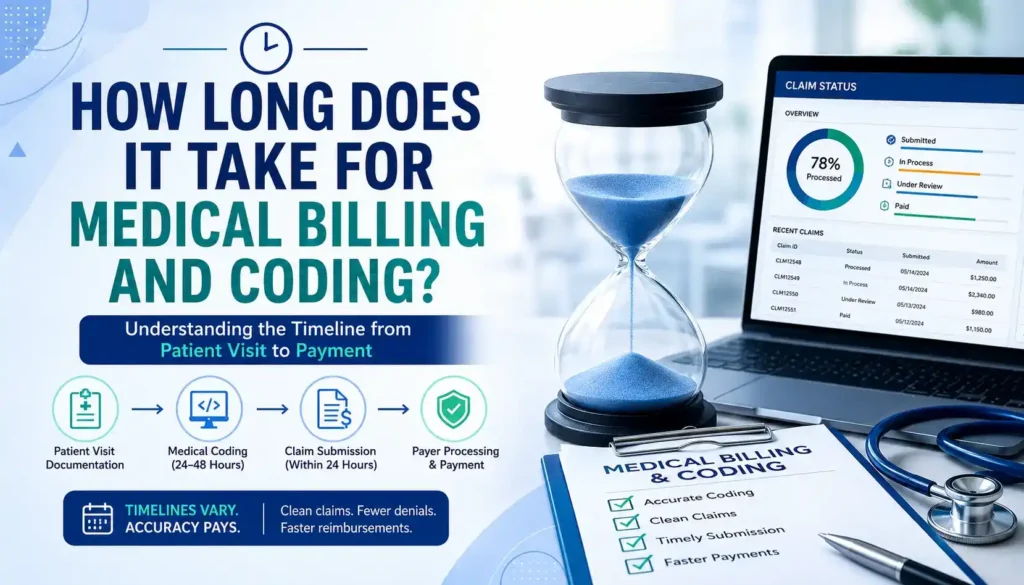
For healthcare providers, one of the most common questions about the revenue cycle is: How Long Does Medical Billing and Coding Take? The answer depends on several factors, including the complexity of the patient encounter, documentation quality, coding requirements, claim accuracy, payer rules, and whether a claim is accepted on the first submission.
In a well-organized medical practice, coding and initial billing can often be completed within 24 to 72 hours after a patient encounter, although more complex cases may take longer. The complete journey from patient visit to insurance payment can take several weeks, depending largely on the payer and whether the claim requires corrections, additional documentation, or an appeal.
For U.S. healthcare providers, understanding these timelines is important because faster processing does not simply mean sending claims quickly. Accurate medical coding and billing services must balance speed with compliance and claim quality. A rushed or inaccurate claim can create more delays through rejections and denials.
Fine Claim LLC helps healthcare providers streamline coding, billing, claim submission, denial management, and other stages of the revenue cycle to support more efficient reimbursement.
What Is the Difference Between Medical Billing and Medical Coding?
Before discussing timelines, it is important to understand that medical billing and medical coding are related but different processes.
Medical coding involves reviewing clinical documentation and translating diagnoses, procedures, treatments, and services into standardized codes. Common coding systems used in the United States include ICD-10-CM, CPT, and HCPCS. AHIMA explains that coding professionals review health records and assign medical codes that support important healthcare functions, including reimbursement.
Medical billing uses the coded information, patient information, insurance details, and other claim data to prepare and submit claims to insurance companies or government programs.
In other words, coding answers “What services and diagnoses were documented?”, while billing helps answer “How should those services be submitted for reimbursement?”
You can learn more about the process in Fine Claim LLC’s guide to what is medical coding and explore professional medical coding services for U.S. healthcare practices.
How Long Does Medical Coding Take?
The time required for medical coding varies according to the complexity of the encounter and the quality of the medical documentation.
For a straightforward office visit with complete documentation, coding may be completed relatively quickly. More complicated encounters involving multiple diagnoses, procedures, modifiers, medical necessity considerations, or extensive documentation may require additional review.
A typical professional workflow may allow routine encounters to move through coding within 24 to 48 hours, while complicated charts may require more time. This should be viewed as a general operational benchmark rather than a universal industry deadline because every practice has different workflows.
Medical coders must also keep current with applicable coding rules and code-set updates. CMS maintains ICD-10 information and publishes annual updates, while HCPCS Level II codes are maintained by CMS.
Accuracy is therefore more important than simply completing a chart as quickly as possible. Incorrect ICD-10 coding, CPT selection, or HCPCS coding can contribute to claim problems and reimbursement delays.
How Long Does Medical Billing Take After Coding?
Once coding is completed, the billing team reviews the claim and prepares it for submission. This stage may include checking demographics, insurance information, provider details, diagnosis and procedure codes, modifiers, authorization information, and other payer-specific requirements.
With an efficient workflow, claims can often be reviewed and submitted within 24 hours after coding. Some practices may submit claims on the same day, while others operate on daily or batch schedules.
This is where charge posting services can make a meaningful difference. Accurate and timely charge capture helps ensure that services documented during the patient encounter are entered correctly before claims are generated. Delayed charge posting can delay the entire billing cycle.
Fine Claim LLC provides charge posting services designed to help healthcare organizations capture billable services accurately and move claims toward submission more efficiently.
How Long Does It Take to Submit a Medical Claim?
After coding and billing review, a clean claim can generally be transmitted electronically through a clearinghouse or directly to the appropriate payer, depending on the provider’s setup and payer requirements.
Electronic submission itself can be very fast, but successful submission does not necessarily mean the claim has been accepted for processing.
CMS explains that electronic Medicare claims are transmitted to the Medicare Administrative Contractor, where claims go through initial edits. Claims containing errors at the front end may be rejected for correction and resubmission.
This distinction is important when discussing medical billing turnaround time. A practice may submit a claim within one day, but if the claim contains incorrect information, it can be returned for correction, adding additional days to the process.
How Long Does Insurance Take to Process a Medical Claim?
Insurance processing time varies considerably among payers and depends on the type of claim, the patient’s insurance plan, claim complexity, electronic versus paper submission, and whether additional information is required.
For many clean electronic claims, payment may be received within a few days to several weeks after successful acceptance. However, there is no single payment timeline that applies to every U.S. insurance payer.
Medicare, Medicaid, commercial insurers, Medicare Advantage plans, workers’ compensation programs, and other payers can have different requirements and processing procedures.
This is why healthcare providers should distinguish between claim submission time and reimbursement time. A billing team can submit a claim promptly, but the payer ultimately controls much of the adjudication and payment timeline.
What Can Delay Medical Billing and Coding?
Several issues can make the medical billing process take longer than expected.
Incomplete clinical documentation is one common problem. If a coder cannot determine the appropriate code from the documentation, additional clarification may be necessary before the claim can be finalized.
Incorrect patient demographics or insurance information can also cause claim rejections. Eligibility problems, missing authorizations, incorrect modifiers, invalid codes, coordination-of-benefits issues, and payer-specific requirements can create additional delays.
Coding complexity is another factor. A routine primary care encounter may be relatively straightforward, while surgical, oncology, cardiology, radiology, behavioral health, or other specialty claims can involve more detailed documentation and coding requirements.
Payer rules also change over time. CMS and other healthcare organizations maintain and update coding and billing requirements, which means billing teams need processes for keeping information current.
What Happens When a Claim Is Rejected or Denied?
A rejected claim and a denied claim are not necessarily the same thing.
A rejection generally occurs before the payer completes full adjudication because the claim fails an initial requirement or contains an error. A denied claim, on the other hand, has been processed by the payer but is not approved for payment as submitted.
Either situation can extend the reimbursement timeline.
For example, suppose a practice completes coding within 24 hours and submits a claim the next day. If the claim is rejected because of an incorrect subscriber ID, the billing team must correct and resubmit it. If the payer later denies the corrected claim because of a coverage or medical necessity issue, additional investigation and potentially an appeal may be required.
That is why denial management services and proactive claim quality control are important parts of an efficient revenue cycle.
Fine Claim LLC’s approach to denial management focuses on identifying causes of denials and supporting corrective action so practices can reduce unnecessary delays.
Does Outsourcing Medical Billing and Coding Make the Process Faster?
Outsourcing does not guarantee a specific reimbursement timeframe, but professional outsourced medical billing services can help practices create a more consistent workflow.
An experienced billing partner can coordinate coding, charge entry, claim scrubbing, submission, payment posting, denial follow-up, and accounts receivable activities. This can be particularly valuable for small and mid-sized practices that do not have enough internal staff to manage every stage of the revenue cycle.
Fine Claim LLC provides medical billing services in the USA covering key revenue cycle functions, including coding, claims submission, insurance verification, denial management, and accounts receivable follow-up.
A coordinated workflow can reduce the time between the patient encounter and claim submission while helping identify issues before they become larger reimbursement problems.
How Fine Claim LLC Helps Improve Billing and Coding Turnaround
Fine Claim LLC works with healthcare providers across the United States to streamline medical billing and coding services through organized workflows, experienced professionals, and technology-supported processes.
The goal is not simply to process claims faster. The goal is to create a billing process in which accurate documentation, coding, charge capture, claim review, submission, and follow-up work together.
Fine Claim LLC reports a claim processing turnaround target of within 24 hours on its medical coding services page, although actual timelines can vary according to practice workflow, documentation, payer requirements, and claim complexity.
For practices managing a high volume of claims, an efficient revenue cycle management strategy can help reduce administrative bottlenecks and improve visibility into outstanding claims and accounts receivable. Fine Claim LLC provides revenue cycle management services designed to support the complete reimbursement process.
Frequently Asked Questions About Medical Billing and Coding Time
How long does it take to code a medical record?
A straightforward medical record may be coded within the same day or within 24 to 48 hours, while complex encounters can require additional review. Documentation quality and coding complexity are major factors.
How long after coding are claims submitted?
With an efficient workflow, claims may be reviewed and submitted within 24 hours after coding. The exact timeframe depends on the practice’s billing process and whether the claim requires additional information.
How long does insurance take to pay a medical claim?
Insurance payment timelines vary by payer and claim. Clean electronic claims may be processed within days or several weeks, while rejected, denied, or complex claims can take considerably longer.
What causes delays in medical billing?
Incomplete documentation, incorrect patient information, eligibility issues, authorization problems, coding errors, missing modifiers, payer requirements, claim rejections, and denials can all extend the reimbursement cycle.
Can outsourcing speed up medical billing?
Outsourcing can help improve workflow consistency and reduce administrative bottlenecks, especially when an experienced billing team manages coding, claims, denials, and accounts receivable together. However, payer processing times remain outside the provider’s direct control.
Final Thoughts: How Long Does Medical Billing and Coding Take?
So, how long does it take for medical billing and coding? For many routine healthcare encounters, coding and initial billing activities can be completed within 24 to 72 hours, provided documentation and billing information are complete. Claim submission can happen shortly afterward, but the complete reimbursement process may take several weeks, depending on payer processing and whether the claim encounters a rejection, denial, or additional documentation request.
The key is not simply speed. Accurate medical coding, clean claim submission, efficient billing workflows, proactive denial management, and consistent accounts receivable follow-up all contribute to a healthier revenue cycle.
For U.S. healthcare providers looking to improve billing efficiency and reduce avoidable delays, Fine Claim LLC offers integrated medical billing, medical coding, and revenue cycle management services tailored to the needs of physician practices, specialty clinics, and healthcare organizations nationwide. Learn more about Fine Claim LLC’s medical billing and RCM solutions and discover how a structured billing workflow can help your practice move from patient encounter to reimbursement more efficiently.