
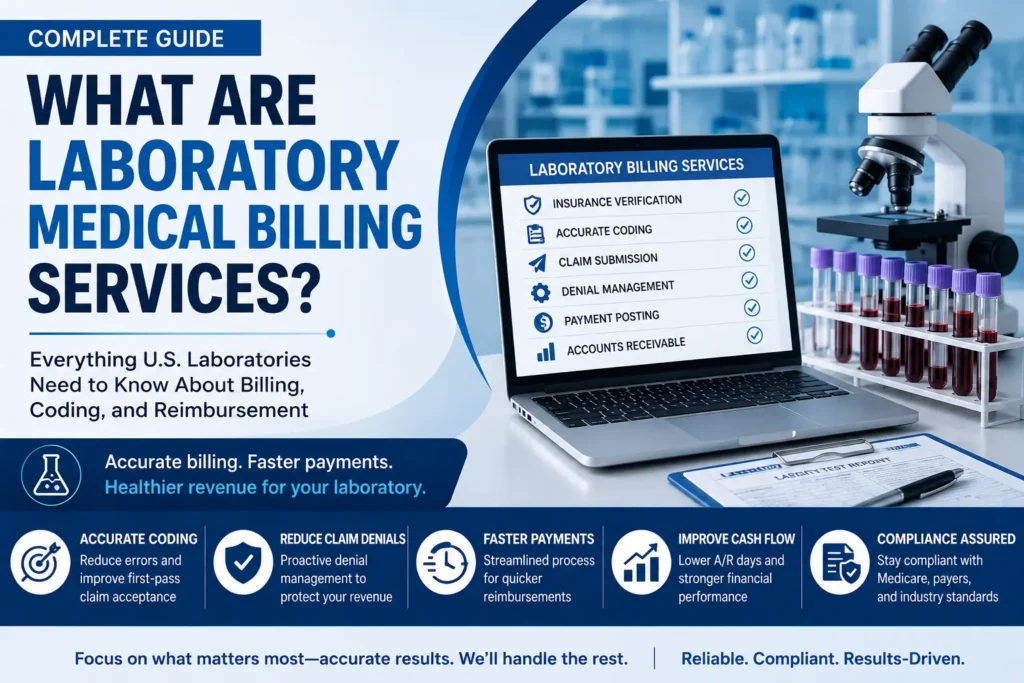
Clinical laboratories play a vital role in the U.S. healthcare system by providing accurate diagnostic testing that helps physicians detect, monitor, and treat a wide range of medical conditions. From routine blood work and pathology testing to molecular diagnostics and genetic screening, laboratories generate essential clinical data that directly influences patient care. However, while laboratory testing is a critical component of healthcare delivery, getting reimbursed correctly for these services is often far more complex than performing the tests themselves.
This is where Laboratory Medical Billing Services become indispensable.
Laboratory billing involves much more than simply submitting insurance claims. Every laboratory test must be documented accurately, assigned the correct CPT and HCPCS codes, supported by appropriate ICD-10 diagnosis codes, and submitted according to payer-specific billing guidelines. Even minor coding errors, missing documentation, incorrect modifier usage, or failure to meet medical necessity requirements can result in denied claims, delayed reimbursements, audits, or revenue loss.
As payer regulations continue to evolve across Medicare, Medicaid, and commercial insurance plans, laboratories face increasing pressure to maintain compliance while maximizing collections. Many independent laboratories, physician office laboratories (POLs), hospital laboratories, and diagnostic testing facilities choose to outsource their revenue cycle operations to experienced billing specialists.
At Fine Claim LLC, we help laboratories streamline their entire revenue cycle through accurate coding, compliant claim submission, proactive denial management, payment posting, and accounts receivable follow-up. Our specialized laboratory billing solutions enable providers to reduce claim denials, accelerate reimbursements, and improve overall financial performance while remaining focused on delivering exceptional patient care.
What Are Laboratory Medical Billing Services?
Laboratory Medical Billing Services refer to the complete process of managing insurance claims, coding, reimbursement, payment collection, and revenue cycle operations for diagnostic laboratories and pathology practices. These services ensure that every laboratory procedure performed is translated into clean, compliant insurance claims that meet payer requirements and are reimbursed accurately.
Laboratory billing specialists work closely with physicians, laboratory staff, coders, and insurance companies to verify patient eligibility, assign appropriate billing codes, submit claims electronically, monitor claim status, resolve denials, and collect outstanding balances.
Unlike many other medical specialties, laboratory billing requires extensive knowledge of:
- CPT laboratory procedure coding
- ICD-10 diagnosis coding
- Medical necessity policies
- National Correct Coding Initiative (NCCI) edits
- Medicare Local Coverage Determinations (LCDs)
- National Coverage Determinations (NCDs)
- CLIA regulations
- Payer-specific laboratory billing guidelines
Because laboratory reimbursement rules frequently change, specialized billing expertise is essential for maintaining compliance and protecting revenue.
Laboratory billing services are commonly used by:
- Independent diagnostic laboratories
- Clinical laboratories
- Hospital laboratories
- Physician office laboratories (POLs)
- Molecular diagnostic laboratories
- Toxicology laboratories
- Pathology laboratories
- Genetic testing laboratories
- COVID-19 and infectious disease testing laboratories
Healthcare organizations seeking to improve operational efficiency often combine laboratory billing with Revenue Cycle Management Services to optimize every stage of the reimbursement process.
Many healthcare providers assume laboratory billing follows the same workflow as general physician billing. In reality, laboratory reimbursement involves significantly more complexity because each test must satisfy payer-specific coverage requirements before reimbursement is approved.How Laboratory Medical Billing Services Work.
Successful laboratory billing follows a structured revenue cycle designed to minimize claim errors while maximizing reimbursement. Every stage of the billing workflow contributes to financial performance.
The process begins with patient registration and insurance verification. Before laboratory testing is performed, patient demographics, insurance coverage, and eligibility should be verified to reduce billing errors and prevent claim rejections.
Once testing is completed, certified coders review physician orders, laboratory reports, and clinical documentation to assign the appropriate CPT, HCPCS, and ICD-10 codes.
Claims are then scrubbed using advanced billing software to identify coding inconsistencies, missing information, payer edits, or compliance risks before electronic submission.
After submission, billing specialists continuously monitor claim status through payer portals and clearinghouses. If claims are rejected or denied, they investigate the underlying issue, correct errors, and resubmit claims promptly.
Once insurance payments are received, payment posting specialists reconcile reimbursements, identify underpayments, and initiate appeals when necessary.
Any remaining patient responsibility is then billed through compliant patient billing processes while accounts receivable specialists follow up on outstanding balances until payment is collected.
Organizations looking to improve reimbursement performance often integrate laboratory billing with Medical Coding Services to ensure coding accuracy across every claim.
Key Components of Laboratory Medical Billing Services
Effective laboratory billing involves much more than claim submission. Every component of the revenue cycle must work together to improve cash flow while maintaining regulatory compliance.
Insurance eligibility verification is the foundation of successful billing. Confirming coverage before laboratory services are performed helps prevent avoidable denials related to inactive insurance, policy exclusions, or authorization requirements.
Accurate laboratory coding ensures every diagnostic procedure is billed according to current CPT, HCPCS, and ICD-10 guidelines. Coding specialists stay updated with annual coding revisions to reduce compliance risks and maximize reimbursement opportunities.
Claim preparation involves validating demographic information, provider credentials, diagnosis codes, procedure codes, modifiers, and payer-specific billing requirements before electronic submission.
Claim scrubbing technology identifies errors before claims reach insurance carriers, significantly increasing first-pass acceptance rates.
Denial management teams review rejected or denied claims, identify root causes, submit corrected claims, and file appeals when reimbursement has been incorrectly denied.
Payment posting ensures insurance reimbursements are accurately recorded while identifying contractual adjustments, underpayments, and outstanding balances.
Accounts receivable follow-up focuses on unpaid claims, aging reports, and payer communication to improve collection rates and reduce outstanding receivables.
Compliance monitoring remains essential throughout the billing process. Laboratories must continually comply with regulations established by Centers for Medicare & Medicaid Services , American Medical Association (AMA CPT®) and Office of Inspector General (OIG) to minimize audit risk and avoid costly penalties.
By integrating these revenue cycle functions, laboratories can improve claim accuracy, reduce reimbursement delays, and maintain healthy financial performance in an increasingly complex healthcare environment.
Common Challenges in Laboratory Medical Billing
Despite technological advancements in healthcare, laboratory billing remains one of the most challenging areas of medical revenue cycle management. Laboratories perform thousands of tests each year, and even a small percentage of billing errors can lead to substantial revenue loss. Understanding these challenges is the first step toward improving reimbursement outcomes.
One of the most common issues is inaccurate or incomplete documentation. Insurance payers require laboratory services to be fully supported by physician orders, clinical notes, and medically necessary diagnosis codes. Missing or inconsistent documentation often results in claim denials or requests for additional information.
Another challenge is the frequent updates to CPT, HCPCS, and ICD-10 coding guidelines. New laboratory tests, revised reimbursement policies, and payer-specific coding requirements require continuous education and monitoring. Without experienced coding professionals, laboratories risk submitting claims with outdated or incorrect codes.
Medical necessity denials are also a significant concern. Medicare and commercial insurance companies evaluate whether the submitted diagnosis justifies the laboratory test performed. If the diagnosis does not align with payer coverage policies, reimbursement may be denied even when the service was appropriately provided.
Laboratories also face increasing pressure to comply with regulations related to CLIA certification, payer audits, and federal healthcare programs. Failure to meet these requirements may result in delayed payments, recoupments, or financial penalties.
In addition, managing aging accounts receivable can become overwhelming without dedicated follow-up teams. Delayed responses to denied or unpaid claims often reduce collection rates and negatively affect cash flow.
Many laboratories overcome these challenges by outsourcing to experienced Medical Billing Company providers that specialize in laboratory revenue cycle management and payer compliance.
Benefits of Outsourcing Laboratory Medical Billing Services
As reimbursement regulations become more complex, many independent laboratories, pathology groups, and physician office laboratories are choosing to outsource their billing operations. A specialized billing partner brings industry expertise, advanced technology, and dedicated revenue cycle professionals that help laboratories improve financial performance.
One of the most significant advantages of outsourcing is increased claim accuracy. Experienced billing specialists understand payer-specific requirements, laboratory coding guidelines, and documentation standards, resulting in cleaner claims and higher first-pass acceptance rates.
Outsourcing also helps laboratories reduce administrative workload. Instead of spending valuable time on claim corrections, appeals, and insurance follow-up, laboratory staff can focus on delivering timely and accurate diagnostic services to patients and referring physicians.
Improved cash flow is another major benefit. Dedicated accounts receivable teams continuously monitor unpaid claims, resolve denials quickly, and pursue outstanding reimbursements, helping laboratories receive payments faster.
Compliance is equally important. Professional billing companies stay current with annual coding updates, Medicare regulations, commercial payer policies, and industry best practices to reduce audit risks and maintain regulatory compliance.
Outsourcing also provides access to advanced billing technology, analytics, reporting dashboards, claim scrubbing tools, and performance metrics that may be expensive for laboratories to implement independently.
Many healthcare organizations combine outsourced laboratory billing with Denial Management Services to proactively identify reimbursement issues before they significantly impact revenue.
Best Practices for Successful Laboratory Revenue Cycle Management
A high-performing laboratory revenue cycle depends on accuracy, efficiency, and continuous improvement. Successful laboratories implement standardized processes that reduce errors while maximizing reimbursement opportunities.
Insurance verification should always be completed before services are performed. Verifying patient eligibility, benefits, and authorization requirements helps minimize preventable claim denials.
Coding accuracy is equally essential. Certified medical coders should review physician documentation carefully to ensure laboratory procedures are assigned the correct CPT, HCPCS, and ICD-10 codes while following current payer guidelines.
Claim scrubbing software should be used before claim submission to identify missing information, coding inconsistencies, invalid modifiers, and payer-specific edits.
Monitoring key performance indicators such as first-pass claim acceptance rate, denial rate, days in accounts receivable, collection ratio, and net reimbursement helps laboratories identify operational inefficiencies before they affect profitability.
Regular staff education is also critical because laboratory billing regulations continue to evolve each year. Ongoing training helps billing teams remain compliant with Medicare policies, commercial insurance updates, and industry coding standards.
Healthcare organizations can further strengthen reimbursement performance by following guidance published by the American Association for Clinical Chemistry and the Clinical Laboratory Improvement Amendments .
Why Choose Fine Claim LLC for Laboratory Medical Billing Services?
Choosing the right billing partner can have a significant impact on a laboratory’s financial success. At Fine Claim LLC, we understand that laboratory billing requires much more than claim submission. It demands deep expertise in coding, payer regulations, compliance, denial prevention, and revenue optimization.
Our experienced billing professionals work closely with independent laboratories, pathology practices, diagnostic centers, and physician office laboratories across the United States to create customized billing solutions that improve operational efficiency and maximize reimbursements.
Our comprehensive laboratory billing solutions include insurance eligibility verification, accurate CPT and ICD-10 coding, electronic claim submission, payment posting, denial management, accounts receivable follow-up, payer communication, and detailed revenue cycle reporting.
Using advanced billing technology and proven quality assurance processes, we help laboratories reduce claim denials, improve first-pass acceptance rates, shorten reimbursement cycles, and maintain compliance with Medicare and commercial insurance requirements.
We also provide transparent reporting and performance analytics that allow healthcare organizations to monitor revenue trends, identify improvement opportunities, and make informed business decisions.
Whether your laboratory performs routine diagnostic testing, molecular diagnostics, pathology services, toxicology testing, or genetic testing, Fine Claim LLC delivers scalable revenue cycle solutions designed to support long-term financial growth.
If your organization is looking to increase collections, reduce administrative burden, and improve billing accuracy, our specialized Revenue Cycle Management Solutions can help your laboratory achieve sustainable success.
Frequently Asked Questions (FAQs)
What are laboratory medical billing services?
Laboratory medical billing services manage the entire reimbursement process for diagnostic laboratories, including insurance verification, medical coding, claim submission, payment posting, denial management, accounts receivable follow-up, and compliance monitoring. These services help laboratories receive accurate and timely reimbursement while reducing administrative workload and claim denials.
Why is laboratory medical billing different from general medical billing?
Laboratory billing requires specialized knowledge of laboratory CPT codes, HCPCS codes, ICD-10 diagnosis coding, Medicare National Coverage Determinations (NCDs), Local Coverage Determinations (LCDs), CLIA regulations, and payer-specific medical necessity requirements. Because laboratory reimbursement rules are more complex, specialized billing expertise is essential to maximize collections and maintain compliance.
What causes laboratory claim denials?
The most common reasons include incorrect CPT or ICD-10 coding, lack of medical necessity, missing physician orders, incomplete patient information, eligibility issues, prior authorization requirements, duplicate billing, and payer-specific documentation errors. Implementing strong coding practices and proactive denial management significantly reduces these issues.
Can outsourcing laboratory medical billing improve revenue?
Yes. Outsourcing to an experienced billing company can increase first-pass claim acceptance rates, reduce administrative costs, improve cash flow, decrease accounts receivable days, strengthen compliance, and allow laboratory staff to focus on patient care rather than billing operations.
Which laboratories benefit from outsourced medical billing services?
Independent diagnostic laboratories, pathology laboratories, molecular diagnostics labs, toxicology laboratories, genetic testing facilities, hospital laboratories, physician office laboratories (POLs), and specialty diagnostic centers can all benefit from professional laboratory medical billing services.
How does Fine Claim LLC help laboratories improve reimbursement?
Fine Claim LLC provides end-to-end laboratory medical billing solutions, including insurance verification, accurate coding, electronic claim submission, denial management, payment posting, accounts receivable follow-up, compliance monitoring, and customized revenue cycle reporting. Our goal is to improve reimbursement accuracy, reduce denials, and maximize financial performance for healthcare organizations across the United States.
Conclusion
Laboratory testing is one of the most essential components of modern healthcare, but the financial success of a laboratory depends just as much on accurate billing as it does on accurate diagnostics. As reimbursement requirements continue to evolve, laboratories must navigate increasingly complex coding guidelines, payer policies, compliance regulations, and documentation standards to ensure timely payment.
Professional Laboratory Medical Billing Services help laboratories simplify these challenges by improving coding accuracy, reducing claim denials, accelerating reimbursements, and strengthening overall revenue cycle performance. Whether you’re operating an independent diagnostic laboratory, a pathology practice, or a physician office laboratory, partnering with an experienced billing provider can significantly enhance operational efficiency and long-term financial stability.
At Fine Claim LLC, we combine industry expertise, advanced billing technology, and a dedicated revenue cycle team to help laboratories across the United States optimize reimbursement while maintaining full compliance with Medicare and commercial insurance requirements. Our customized solutions are designed to reduce administrative burdens, improve cash flow, and allow healthcare providers to focus on what matters most—delivering high-quality patient care.
If you’re looking for a trusted partner to streamline your laboratory billing process and maximize revenue, Fine Claim LLC is here to help.
Every laboratory procedure requires accurate CPT coding. Incorrect coding can immediately trigger claim denials or underpayments. Certain tests require modifiers, while others must meet frequency limitations established by Medicare or commercial insurers.
Medical necessity is another major challenge. Insurance companies require laboratory tests to be supported by diagnosis codes that justify why the test was medically necessary. If the diagnosis does not meet payer guidelines, reimbursement may be denied even if the laboratory performed the test correctly.
Many advanced diagnostic procedures also require prior authorization, documentation review, or additional clinical information before payment can be approved.
In addition, laboratories frequently bill multiple insurance carriers with different reimbursement rules, making consistent claim accuracy increasingly difficult without experienced billing professionals.
This is why many organizations partner with experienced Medical Billing Services providers that specialize in laboratory reimbursement.