
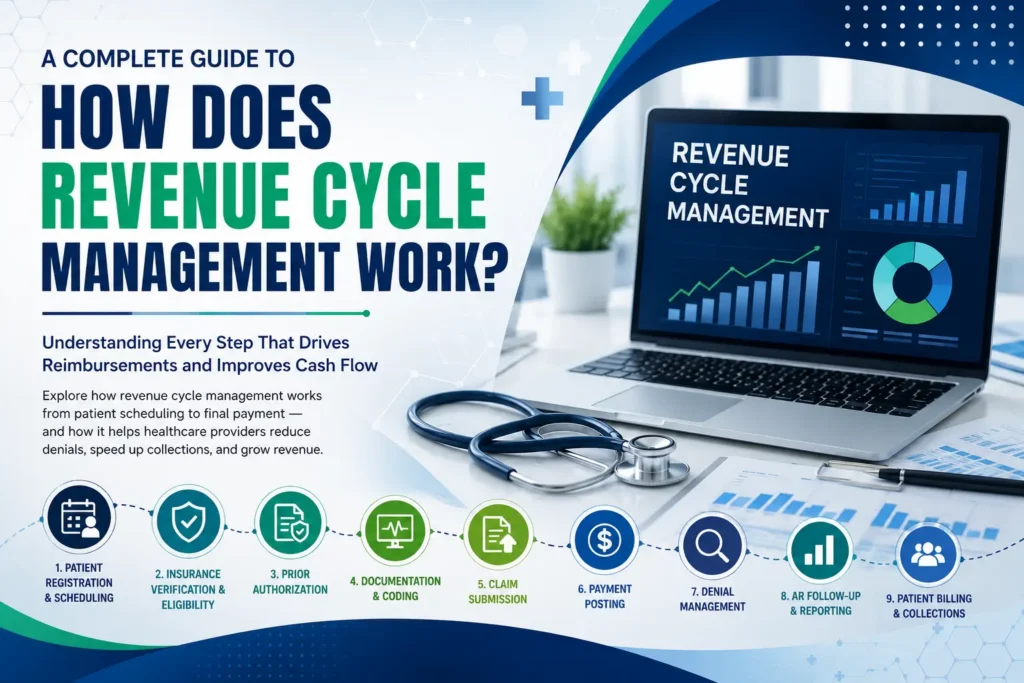
Every successful healthcare practice depends on more than excellent patient care. Behind every appointment, treatment, and procedure is a financial process that determines whether providers receive accurate and timely reimbursement. This process is known as Revenue Cycle Management (RCM), and it plays a critical role in maintaining the financial health of medical practices across the United States.
Many providers ask, how does revenue cycle management work, especially as insurance regulations, coding requirements, and reimbursement policies continue to evolve. Understanding the complete revenue cycle helps physicians reduce claim denials, improve cash flow, increase operational efficiency, and deliver a better patient experience.
At Fine Claim LLC, we help healthcare organizations optimize every stage of the revenue cycle by combining experienced billing professionals, certified medical coders, and technology-driven workflows. Whether you operate an independent physician practice, specialty clinic, or multi-location healthcare organization, an efficient RCM strategy ensures sustainable financial growth while allowing providers to focus on patient care.
What Is Revenue Cycle Management?
Revenue Cycle Management is the complete financial process healthcare providers use to track patient revenue from the moment an appointment is scheduled until the final payment is collected and posted.
Unlike medical billing, which mainly focuses on submitting insurance claims, Revenue Cycle Management covers every financial interaction between a patient, provider, and payer. It integrates administrative, clinical, and financial processes into one streamlined workflow.
A well-managed revenue cycle minimizes delays, prevents billing errors, reduces denied claims, and improves reimbursement rates.
Healthcare organizations throughout the United States increasingly rely on comprehensive RCM services because payer rules, coding guidelines, and regulatory requirements become more complex every year.
Providers that invest in professional revenue cycle management often experience improved operational efficiency, lower administrative costs, and healthier financial performance.
Why Revenue Cycle Management Matters
Healthcare reimbursement has become increasingly challenging due to changing payer policies, prior authorization requirements, value-based care initiatives, and stricter documentation standards.
Without an effective RCM process, practices commonly experience:
- Delayed reimbursements
- Increased claim denials
- Higher accounts receivable balances
- Poor patient billing experiences
- Lost revenue opportunities
- Increased administrative workload
Revenue Cycle Management helps eliminate these problems by ensuring every stage of the billing process is completed accurately and efficiently.
For many providers, partnering with experienced companies like Fine Claim LLC results in faster reimbursements, improved clean claim rates, and long-term financial stability.
How Does Revenue Cycle Management Work?
Revenue Cycle Management is a continuous process rather than a single task. Every step affects the next, making accuracy essential throughout the entire patient journey.
The revenue cycle begins long before medical billing and continues until every outstanding balance has been resolved.
Patient Scheduling and Registration
The revenue cycle starts when a patient schedules an appointment.
Accurate demographic information, insurance details, contact information, and provider selection must all be collected during registration.
Even small registration mistakes can lead to denied claims later in the billing process.
Best practices include verifying:
- Patient identity
- Insurance policy information
- Subscriber details
- Primary and secondary insurance
- Referral requirements
- Contact information
Many reimbursement delays originate from inaccurate patient registration rather than billing errors.
Practices that prioritize accurate registration significantly improve first-pass claim acceptance rates.
This stage naturally connects with Eligibility Verification Services, helping providers confirm insurance coverage before treatment begins.
Insurance Eligibility Verification
Insurance verification is one of the most important components of Revenue Cycle Management.
Before services are provided, staff members verify:
- Active insurance coverage
- Copay requirements
- Deductibles
- Coinsurance
- Prior authorization requirements
- Covered services
- Network participation
Verifying benefits before appointments prevents claim denials and reduces unexpected patient balances.
Healthcare organizations that skip eligibility verification often experience unnecessary payment delays and increased patient dissatisfaction.
Practices looking to improve reimbursement accuracy frequently invest in Eligibility Verification Services, which reduce preventable claim denials before they occur.
Prior Authorization
Many diagnostic procedures, surgeries, imaging studies, and specialty treatments require insurance approval before services are performed.
Obtaining authorization involves submitting clinical documentation to insurance companies and receiving approval before treatment.
Failure to obtain prior authorization may result in complete claim denial—even when the medical service was necessary.
Efficient Revenue Cycle Management includes tracking authorization status, expiration dates, and payer-specific requirements.
This stage works closely with Medical Billing Services to ensure approved procedures match submitted claims.
Medical Documentation
Once patient care has been delivered, providers must document every diagnosis, treatment, procedure, and clinical finding accurately.
Documentation forms the foundation for coding and billing.
Incomplete documentation often leads to:
- Coding errors
- Medical necessity denials
- Downcoding
- Compliance risks
- Delayed reimbursement
Healthcare providers should ensure documentation supports every billed procedure according to payer guidelines.
Organizations frequently reference guidance from the Centers for Medicare & Medicaid Services (CMS) to maintain documentation compliance and billing accuracy.
Medical Coding
Certified medical coders convert clinical documentation into standardized codes used by insurance companies.
Medical coding includes:
- ICD-10-CM diagnosis codes
- CPT procedure codes
- HCPCS Level II codes
Accurate coding ensures providers receive appropriate reimbursement while maintaining regulatory compliance.
Incorrect coding may result in:
- Underpayments
- Overpayments
- Audits
- Claim denials
- Compliance issues
Experienced coders review documentation carefully before assigning codes that accurately represent services performed.
Practices seeking higher coding accuracy often rely on Medical Coding Services supported by certified coding professionals.
Charge Capture and Charge Entry
After coding is completed, all billable services must be entered accurately into the practice management system.
Charge capture ensures no performed service goes unbilled.
Missing charges directly reduce provider revenue and create financial leakage that may never be recovered.
Charge entry specialists verify:
- Procedure codes
- Diagnosis codes
- Modifiers
- Units
- Provider information
- Place of service
- Payer requirements
Accurate charge entry lays the groundwork for successful claims processing.
Practices often improve financial performance by implementing Charge Posting Services and automated reconciliation workflows.
After patient registration, insurance verification, medical documentation, coding, and charge entry are completed, the revenue cycle moves into the reimbursement phase. This is where claims are submitted, payments are processed, denied claims are appealed, and outstanding balances are collected. Each step directly impacts a practice’s cash flow and overall financial performance.
Claim Submission
Once charges have been entered and reviewed, claims are prepared for submission to insurance payers. Before transmission, most healthcare organizations use claim-scrubbing software to identify coding inconsistencies, missing information, invalid modifiers, or payer-specific formatting errors.
Submitting a clean claim the first time significantly improves reimbursement speed and reduces administrative costs.
Electronic claim submission has become the industry standard across the United States because it shortens processing times and minimizes manual errors. Claims are typically routed through clearinghouses before reaching commercial insurance companies, Medicare, or Medicaid.
An effective RCM team carefully monitors claim acceptance reports to identify rejected claims immediately and correct them before delays affect cash flow.
Practices that invest in Medical Billing Services often achieve higher first-pass claim acceptance rates because experienced billing specialists understand payer-specific submission requirements.
Payment Processing and Remittance Review
After an insurance payer adjudicates a claim, the provider receives an Electronic Remittance Advice (ERA) or Explanation of Benefits (EOB). These documents explain how the claim was processed, what amount was paid, and whether any adjustments or denials were applied.
Revenue Cycle Management professionals review every remittance to verify that payments match contracted reimbursement rates.
If discrepancies exist, they investigate whether the payer underpaid, incorrectly denied a service, or applied contractual adjustments improperly.
Accurate payment reconciliation ensures providers receive every dollar they have earned while preventing unnoticed revenue loss.
Healthcare organizations frequently reference guidance published by the American Medical Association (AMA) to stay informed about coding updates and reimbursement practices.
Payment Posting
Payment posting is more than recording deposits into a billing system. It serves as a financial checkpoint that verifies payments received from insurance companies and patients match expected reimbursement amounts.
During payment posting, billing specialists:
- Record insurance payments
- Post patient payments
- Apply contractual adjustments
- Identify underpayments
- Detect overpayments
- Reconcile balances
- Flag denied or partially paid claims
Accurate posting provides complete visibility into practice revenue and allows billing teams to identify trends affecting collections.
Many organizations improve financial reporting through dedicated Payment Posting Services, ensuring every transaction is accurately reconciled.
Denial Management
Even high-performing healthcare organizations receive denied claims. The difference between successful and struggling practices is how quickly and effectively they respond.
Denial management involves identifying the reason for each denial, correcting the issue, resubmitting eligible claims, and implementing preventive measures to reduce future denials.
Common reasons include:
- Missing patient information
- Incorrect diagnosis codes
- Invalid procedure modifiers
- Lack of medical necessity
- Expired authorizations
- Duplicate claims
- Filing after payer deadlines
Instead of treating denials as isolated events, experienced RCM teams analyze denial trends to uncover systemic issues within registration, coding, documentation, or billing workflows.
At Fine Claim LLC, denial management focuses not only on recovering lost revenue but also on improving upstream processes to prevent recurring denials.
Healthcare providers seeking stronger financial performance often benefit from specialized Denial Management Services that prioritize root-cause analysis and timely appeals.
Accounts Receivable Follow-Up
Claims are not always paid promptly. Outstanding balances that remain unpaid after initial submission move into Accounts Receivable (AR).
AR follow-up specialists communicate with insurance companies to determine claim status, resolve payment delays, submit additional documentation, and appeal denied claims when necessary.
Timely follow-up is essential because many insurance companies impose strict deadlines for reconsiderations and appeals.
A healthy Accounts Receivable process helps providers:
- Reduce aging balances
- Improve collection rates
- Increase monthly cash flow
- Identify recurring payer issues
- Shorten reimbursement cycles
Industry benchmarks generally recommend keeping the majority of receivables under 60 days, as older balances become progressively more difficult to collect.
Practices often strengthen collections by partnering with experienced Accounts Receivable (AR) Management Services providers who proactively monitor unpaid claims.
Patient Billing and Collections
As high-deductible health plans become more common across the United States, patient responsibility now represents a larger share of healthcare revenue.
Revenue Cycle Management extends beyond insurance reimbursement to include accurate patient billing and transparent communication.
Patients should receive easy-to-understand statements that clearly explain:
- Insurance payments
- Remaining balances
- Copay obligations
- Deductibles
- Coinsurance
- Available payment options
Offering online payment portals, payment plans, and digital statements improves the patient financial experience while increasing collection rates.
Clear communication also reduces billing disputes and strengthens patient satisfaction.
Compliance Throughout the Revenue Cycle
Every stage of Revenue Cycle Management must comply with federal regulations and payer requirements.
Healthcare organizations are expected to protect patient information, maintain accurate documentation, and follow nationally recognized coding standards.
Compliance includes adherence to HIPAA Compliance Services, proper documentation practices, secure data management, and current coding guidelines.
Regular internal audits help identify potential risks before they result in payer audits, financial penalties, or reimbursement delays.
Organizations also monitor updates from the Office of Inspector General (OIG) to strengthen compliance programs and reduce fraud and abuse risks.
Technology’s Role in Modern Revenue Cycle Management
Technology has transformed Revenue Cycle Management by automating repetitive administrative tasks and providing greater financial visibility.
Modern RCM platforms support:
- Electronic Health Record (EHR) integration
- Electronic claim submission
- Automated eligibility verification
- Claim scrubbing
- Denial tracking
- Real-time reporting
- Revenue analytics
- Patient payment portals
Automation reduces manual errors, accelerates reimbursement, and allows billing professionals to focus on higher-value activities such as denial resolution and financial analysis.
However, technology alone cannot maximize revenue. Human expertise remains essential for interpreting payer policies, resolving complex claims, and ensuring compliance with constantly changing regulations.
At Fine Claim LLC, experienced billing professionals combine advanced technology with industry expertise to deliver accurate, efficient, and compliant Revenue Cycle Management solutions tailored to healthcare providers across the United States.
Key Performance Indicators (KPIs) That Measure Revenue Cycle Success
An effective Revenue Cycle Management strategy relies on continuous performance monitoring. Healthcare organizations use Key Performance Indicators (KPIs) to evaluate financial health and identify opportunities for improvement.
Common RCM metrics include clean claim rate, first-pass claim acceptance rate, denial rate, average reimbursement time, net collection rate, days in Accounts Receivable, patient collection rate, and overall revenue realization.
Monitoring these metrics helps practices make data-driven decisions, improve operational efficiency, and maintain consistent cash flow.
Providers that regularly review financial performance are better positioned to respond to payer changes, optimize workflows, and sustain long-term profitability.
Frequently Asked Questions
How does revenue cycle management work in healthcare?
Revenue Cycle Management (RCM) works by managing every financial step associated with patient care—from appointment scheduling and insurance verification to medical coding, claim submission, payment posting, denial management, and patient collections. The goal is to ensure healthcare providers receive accurate and timely reimbursement while maintaining compliance with payer and federal regulations.
What is the purpose of revenue cycle management?
The primary purpose of Revenue Cycle Management is to maximize revenue, reduce claim denials, improve cash flow, shorten reimbursement timelines, and create a more efficient billing process. A strong RCM strategy also enhances the patient financial experience by providing transparent billing and payment options.
What are the stages of Revenue Cycle Management?
The revenue cycle generally includes:
- Patient scheduling and registration
- Insurance eligibility verification
- Prior authorization
- Medical documentation
- Medical coding
- Charge capture
- Claim submission
- Payment posting
- Denial management
- Accounts Receivable (AR) Management
- Patient billing and collections
- Reporting and financial analysis
Each stage depends on the accuracy of the previous one, making a well-managed workflow essential for maximizing reimbursement.
Why do healthcare providers outsource Revenue Cycle Management?
Many healthcare organizations outsource RCM because managing insurance regulations, coding updates, compliance requirements, and payer policies requires specialized expertise. Outsourcing helps reduce administrative burdens, improve clean claim rates, lower denial rates, accelerate reimbursements, and allow providers to focus more on patient care.
How can Revenue Cycle Management improve profitability?
Revenue Cycle Management improves profitability by reducing billing errors, preventing revenue leakage, accelerating collections, minimizing denied claims, improving payer reimbursements, and optimizing operational efficiency. A well-managed revenue cycle creates predictable cash flow and supports long-term financial stability.
Why Choose Fine Claim LLC for Revenue Cycle Management?
Managing Revenue Cycle Management internally has become increasingly challenging due to evolving payer policies, changing reimbursement models, and growing administrative complexity. Healthcare providers need more than billing support—they need a strategic partner that understands the entire revenue cycle.
Fine Claim LLC delivers comprehensive Revenue Cycle Management services designed specifically for healthcare providers across the United States. Our experienced billing specialists, certified medical coders, and revenue cycle professionals work together to optimize every stage of the reimbursement process.
From patient registration and insurance verification to coding, claim submission, denial management, payment posting, and accounts receivable follow-up, we focus on improving operational efficiency while maximizing collections.
Our data-driven approach helps healthcare organizations:
- Increase clean claim rates
- Reduce claim denials
- Improve reimbursement turnaround times
- Strengthen compliance
- Lower administrative costs
- Improve patient billing experiences
- Maximize long-term financial performance
Whether you are an independent physician, specialty clinic, medical group, or multi-location healthcare organization, Fine Claim LLC provides scalable Revenue Cycle Management solutions tailored to your practice’s unique needs.
Conclusion
Understanding how does revenue cycle management work is essential for every healthcare organization seeking sustainable financial success. Revenue Cycle Management is not simply about submitting insurance claims—it is a comprehensive process that connects clinical care with financial performance.
Every phase, from patient registration and eligibility verification to coding, claims processing, denial resolution, payment posting, and patient collections, contributes to the overall health of a medical practice. Even minor errors early in the cycle can result in delayed reimbursements, increased administrative costs, and lost revenue.
By implementing efficient Revenue Cycle Management strategies and partnering with experienced professionals like Fine Claim LLC, healthcare providers can improve cash flow, reduce denials, enhance compliance, and focus more on delivering exceptional patient care.
As the U.S. healthcare industry continues to evolve, investing in a modern, technology-enabled Revenue Cycle Management process is no longer optional—it is a strategic necessity for long-term growth and financial stability.